
No products in the cart.
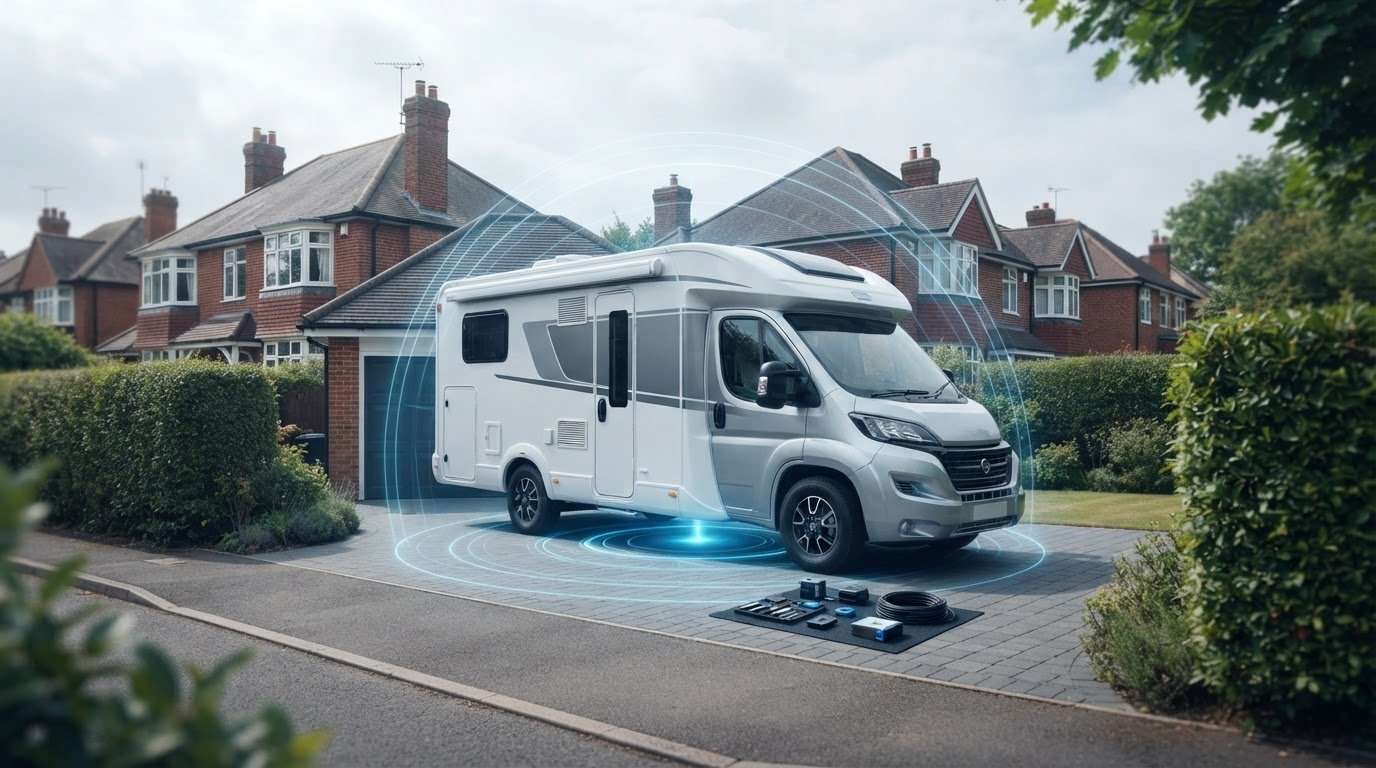
Tracking for Motorhomes: Choosing the Right UK Security
Choosing the Right UK Security
The most advanced Tracking for Motorhomes isn’t automatically the right choice for your motorhome. The right option depends on your insurer’s requirements, your vehicle and how you want it protected when it’s unattended. Choosing a motorhome tracker can feel complicated, especially when you’re comparing S5 and S7 classifications.
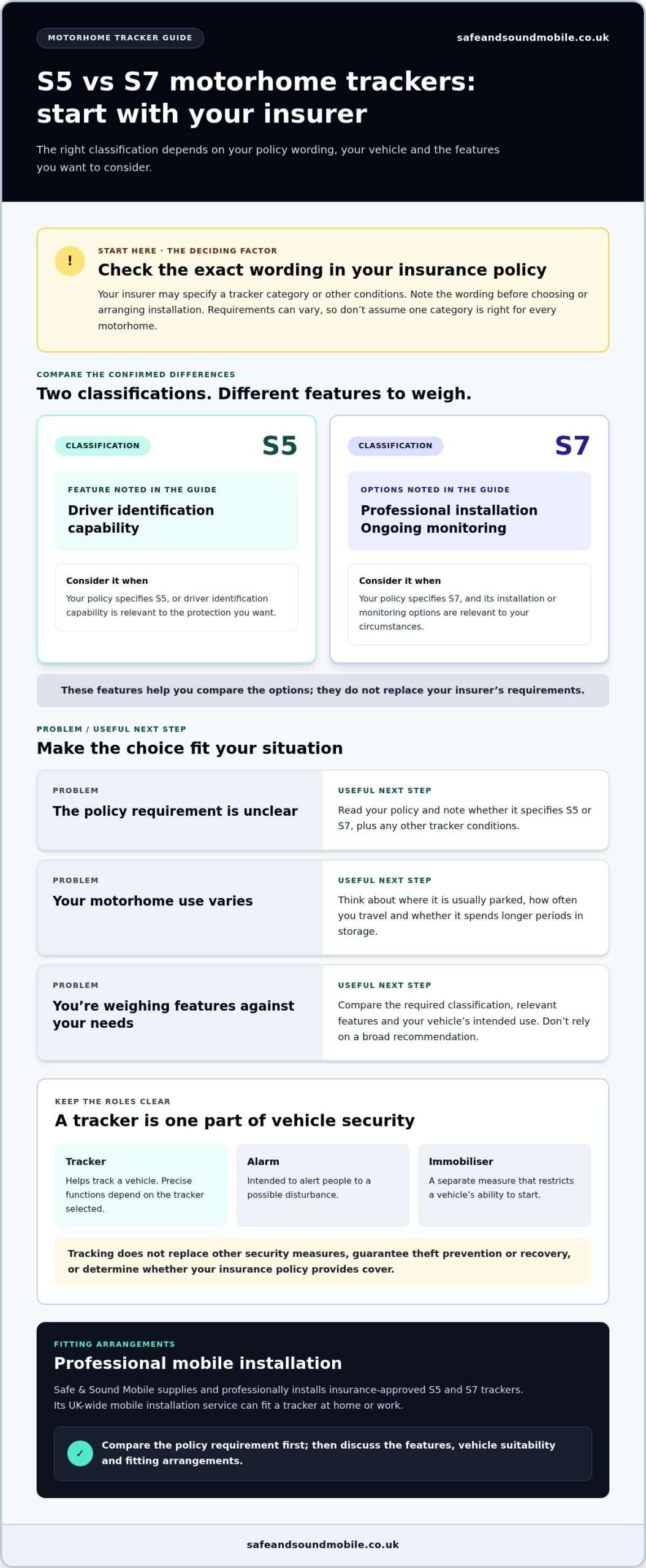
Start by checking your insurance policy before arranging an installation. Your insurer may specify a tracker category, so note the exact wording and any conditions. S5 trackers include driver identification, while S7 trackers offer professional installation and ongoing monitoring. These differences help you compare options, but your insurer’s requirements should guide your decision.
This guide explains what to compare, how your motorhome’s use can shape your priorities and what to expect from professional fitting. Safe & Sound Mobile supplies and professionally installs insurance-approved S5 and S7 trackers, with vehicle-specific advice to help you choose. Its UK-wide mobile installation service can fit your tracker at home or work, so you don’t need to travel to an installation location. You’ll also find practical steps for preparing for a fitting appointment.
Key Takeaways
- Start by checking your insurer’s requirements. Note the exact wording before choosing an S5 or S7 tracker.
- Compare tracker options against your motorhome, how you use it, the required classification and the fitting arrangements that suit you.
- Understand the differences between S5 and S7 trackers, rather than assuming one category fits every motorhome.
- Professional mobile fitting capability at home or your worksite, so you can arrange installation without travelling to a fitting location.
- Safe & Sound Mobile supplies and fits insurance-approved S5 and S7 trackers, backed by a lifetime tracker warranty.
Why motorhome owners consider a dedicated motorhome tracker
A motorhome tracker is a vehicle security device that helps track a vehicle. For owners, motorhome tracking adds a location-focused layer to their broader security plan. A vehicle tracking system uses technology to determine or report a vehicle’s location, though its exact functions depend on the tracker you choose.
Motorhomes have varied routines. One may be used for frequent touring, while another stays parked for much of the year between trips. These patterns can shape what an owner prioritises: convenience during regular use, security while the vehicle is stored, or a balance of both. No single security setup suits every motorhome and owner.
How motorhome use affects tracker priorities
Before comparing trackers, consider where you usually park your motorhome, how often you travel, and how long you may leave it unused. A motorhome used regularly has different day-to-day considerations from one kept in storage between holidays. The vehicle itself, how you plan to use it, and the security measures you already have can also inform your choice.
Write down your typical travel routine and any longer storage periods. Then consider what you want a tracker to contribute to your wider security plan. For example, an owner who tours regularly may focus on practical arrangements for a vehicle in frequent use. In contrast,e an owner who stores a motorhome between trips may want to consider how the tracker fits into that arrangement. These are useful starting points, not rules that automatically point to a particular classification.
What a tracker can and cannot promise
A tracker’s role is to help track a vehicle. It is not the same as an alarm, an immobiliser or insurance cover. An alarm is intended to alert people to a possible disturbance; an immobiliser is a separate security measure that restricts a vehicle’s ability to start. A tracker lets you track the vehicle, but it doesn’t replace those measures or guarantee that a theft will be prevented or the motorhome recovered.
What happens after an incident depends on the circumstances and the tracker’s functions. Treat tracking as one part of a broader vehicle-security approach, not as a promise of a particular result. It’s also separate from an insurer’s decision. A tracker doesn’t determine whether a policy provides cover or whether an insurer will accept a particular classification. Policy requirements can vary, so read your policy wording and use it to guide your choice.
Keep three questions separate as you compare options: what your insurance policy requires, what role you want a tracker to play, and how it fits alongside your other security measures. This makes it easier to distinguish a policy condition from a personal preference. Once you’ve identified the requirement, compare the S5 and S7 classifications with your motorhome’s needs.
S5 vs S7 motorhome trackers: understand the differences
Choosing between S5 and S7 starts with your insurance policy, not a general claim that one category is best. Insurers can set different requirements, so check the wording that applies to your motorhome before selecting a tracker. Safe & Sound Mobile supplies and professionally installs insurance-approved S5 and S7 trackers, with vehicle-specific advice to help you compare the options.
The key difference is that S5 trackers include driver identification, while S7 trackers offer professional installation and ongoing monitoring options. These features give you a starting point for comparison, but they don’t replace your insurer’s requirements as the deciding factor. Match the classification to your policy, then consider which features suit your circumstances.
When an S5 tracker may fit your requirements
An S5 tracker may suit your needs if your insurer’s policy wording specifies S5, or if you need driver identification for the protection you want. That feature distinguishes S5 in this comparison, but it doesn’t mean every motorhome owner needs this classification. Confirm the category your insurer requires, then compare it with the tracker options available for your vehicle.
Safe & Sound Mobile supplies insurance-approved S5 trackers and provides professional fitting. Use your policy wording as your reference point, rather than assuming your motorhome’s value, age, or use automatically determines which category you need. This keeps the decision tied to your own requirements.
How to assess an S7 tracker
S7 is also an insurance-approved option offered by Safe & Sound Mobile. S7 trackers offer professional installation and ongoing monitoring. These features may matter, but they don’t make S7 the right choice for every motorhome. Your insurer’s required classification remains central, so compare the policy wording with the tracker category before arranging a fitting.
Use this checklist to compare the options:
- Policy wording: Identify whether your insurer specifies S5 or S7, and note any other tracker conditions.
- Relevant features: Consider whether S5 driver identification or S7 ongoing monitoring matters to you.
- Vehicle suitability: Include your motorhome and its intended use in the discussion instead of relying on a broad recommendation.
- Professional fitting: Consider how and where installation will be arranged as part of your overall choice.
Don’t treat the labels as a simple ranking. S5 and S7 are different classifications, and the useful comparison is how each aligns with your insurer’s stated requirement and your priorities. If your policy wording is unclear, ask your insurer to clarify the requirement before choosing. Selecting a category alone doesn’t guarantee policy acceptance or a change to your premium.
Once you know which classification your policy requires, Safe & Sound Mobile can help you choose a suitable option and arrange professional installation. Explore insurance-approved motorhome trackers as part of your comparison.
How to compare motorhome tracker options for your situation
A useful comparison starts with your insurance policy, then considers how you use your motorhome and how you can arrange installation. These priorities help separate essential conditions from personal preferences. Insurer requirements vary, so don’t assume a tracker classification, installation or feature will automatically change your cover or reduce your premium.
Start with your motorhome insurance requirements.
Read your policy documents and note any stated tracker classification or installation conditions. If the wording specifies S5 or S7, make that a key requirement in your comparison. If itdoesn’tt clearly state a category, don’t rely on a general rule about which tracker motorhomes usually need. Let your insurer’s requirements guide your choice.
Separate policy conditions from preferences. A required classification is a condition to resolve; features you’d find useful are personal considerations. Installing a tracker doesn’t guarantee an insurer will accept it, alter your policy, or reduce your premium. Keep the policy wording to hand as you compare options, and ask your insurer about any uncertainty in its requirements.
Match the tracker choice to ownership and fitting needs.
Next, consider your routine. A motorhome used for regular touring may have different practical priorities from one parked between trips. Consider how you use it and how long it may sit unused; features matter most. Neither category is automatically superior for every owner.
Use this simple comparison framework to keep the decision focused:
Policy wording: Which category or fitting conditions, if any, does your insurer specify?
Vehicle use: How do your touring and parking routines shape your priorities?
Classification and features: Does S5 driver identification capability or an S7 option better match your preferences while meeting the policy requirement?
Fitting arrangements: Where would it be most convenient to have the installation carried out?
Give the policy requirement priority, then weigh your preferences and practical arrangements. For example, if your documents specify S7, a preference for a feature associated with another category doesn’t override that condition. Resolve the insurance requirement first, then compare suitable options based on what matters to you.
Safe & Sound Mobile provides professional mobile installation at home or work nationwide. This can make arranging a fitting more convenient if travelling to an installation location doesn’t suit your schedule. Include the fitting location in your decision rather than treating it as an afterthought.
This structured approach makes it easier to assess tracking needs without relying on broad claims about what every owner needs. Safe & Sound Mobile offers vehicle-specific advice on its insurance-approved motorhome tracker options, helping you consider classification, features, and fitting.
What to expect when arranging motorhome tracker fitting
Start by discussing your motorhome and priorities, using your insurance wording to guide your choice, and arranging professional fitting in a practical location. Safe and Sound Mobile provides nationwide mobile fitting at home or work, so you don’t need to travel to an installation site. Vehicle-specific advice helps connect your requirements with a suitable insurance-approved S5 or S7 tracker.
Have the relevant information ready before discussing your options. This keeps the conversation focused on your vehicle, policy requirements, and preferred fitting arrangements. Then you can compare tracker options against your needs rather than choosing based on a general recommendation.
Preparing for a mobile fitting appointment
Have your motorhome details and relevant insurance policy wording available. Note any tracker classification or fitting condition stated in your documents, along with the questions you want answered. Decide whether home or work is the more practical fitting location. These preparations make it easier to discuss your requirements and arrange a suitable mobile installation.
Think about access to your motorhome at the chosen location and whether one place is more convenient than the other. The goal is to choose a practical appointment setting. Vehicle-specific advice can help you choose the right tracker before you arrange the fitting, so you don’t have to settle every detail on your own.
What professional fitting adds
Professional installation is part of Safe and Sound Mobile’s tracker offering. The service combines advice and fitting, with the option of a mobile appointment at home or work nationwide. Vehicle-specific advice accounts for your motorhome, not just the classification shown in a product description.
The process can be thought of in a few clear stages:
- Discuss your needs. Share relevant motorhome details and the policy wording that describes your insurer’s tracker requirements.
- Consider suitable options. Use vehicle-specific advice to compare an insurance-approved S5 or S7 tracker with those requirements and your priorities.
- Arrange the fitting location. Choose a practical home or work address for mobile installation.
- Have the tracker professionally fitted. The fitting is included with the selected tracker solution.
Don’t assume a standard fitting duration or a specific installation process. Prepare by having your vehicle and policy information ready, and choose a mobile appointment that works best. This keeps expectations clear without relying on details that may vary by vehicle or arrangement.
For owners considering motorhome tracking, mobile fitting can simplify the practical side of choosing a suitable option. Arrange professional motorhome tracker fitting with Safe and Sound Mobile, with nationwide installation at home or work.
Choose Safe and Sound Mobile for motorhome tracker supply and fitting.
Choosing a tracker is easieris easier when supply, vehicle-specific advice, and professional fitting come together. Safe and Sound Mobile supplies and installs insurance-approved S5 and S7 trackers for motorhome owners across the UK. Its mobile fitting service can be arranged at home or work, helping you organise installation around when your motorhome is kept.
Don’t treat the classifications as a simple ranking. S5 trackers include driver identification, while S7 trackers offer ongoing monitoring. Your insurer’s choice depends on their requirements and the features that matter to you. Safe and Sound Mobile can provide vehicle-specific advice to help you consider the options for your motorhome and policy wording.
A tracker option backed by professional installation
Professional installation is part of the tracker service. Arranging the fitting at your home or workplace can be practical if your motorhome is stored away from a convenient installation location, or if you’d rather not plan a separate journey. Nationwide mobile fitting brings the service to you, so you don’t have to travel to a fitting site.
Tracker products include a Lifetime Warranty on Trackers. This warranty applies to trackers, not other vehicle products. Professional fitting and vehicle-specific advice are also worth considering as you choose the insurance-approved option that best fits your needs.
Take the next step towards motorhome tracking.
Before getting in touch, have your motorhome details and relevant insurance wording ready. This gives the team useful context to discuss your vehicle, your insurer’s tracker classification, nd whether S5 or S7 is the right option. You can also consider whether fitting at home or work is more convenient.
Focus the discussion on the details that apply to your motorhome, rather than general assumptions about owners or policies. Safe and Sound Mobile can talk through its S5 and S7 tracker options and professional mobile fitting. Your insurer remains the source for policy requirements and cover decisions; fitting a tracker doesn’t guarantee any premium reduction.
If you’re ready to take the next step, discuss a motorhome tracker and request a price from Safe and Sound Mobile. Share your vehicle details and policy requirements to get motorhome-specific advice and a price. With nationwide mobile installation at home or work, you can consider the tracker and fitting arrangements together.
Take the time to choose motorhome tracking with your insurer, rather than rushing your decision about how a tracker fits your vehicle plans. insurer, rather than rushing, take the time to consider your requirements so the next conversation is more focused and you can make a more considered decision for your motorhome.
You don’t need to have every technical detail worked out in advance. Bring your questions and the information you have about your vehicle and policy, then take the decision one step at a time. The aim is an informed choice, not a promise that any tracker can prevent theft or guarantee recovery.
Speak with Safe and Sound Mobile about your motorhome tracker and take a practical next step towards choosing an option that suits your needs. Having your vehicle and policy details ready can make the discussion more useful.
Frequently Asked Questions
Does a motorhome tracker guarantee that a stolen vehicle will be recovered
No. A motorhome tracker can’t guarantee recovery or prevent theft. Motorhome tracking is a security measure, but what happens after a theft depends on the circumstances and the information available. If your motorhome is stolen, report it to your insurer and follow their claims process. View a tracker as one part of your wider security arrangements, not a guarantee of recovery.
Can a motorhome tracker reduce my insurance premium?
A tracker may affect how an insurer assesses your risk, but it doesn’t guarantee a lower premium. Insurers set their own requirements and may specify a tracker category or other conditions. Before arranging installation, ask your insurer whether a tracker affects your particular policy and what evidence it needs. Having a tracker doesn’t, by itself, confirm that your insurer will change your premium or cover.
How much does a motorhome tracker cost?
The price depends on the tracker option you choose. Safe and Sound Mobile provides a price on request rather than publishing a single cost that applies to every motorhome tracker. Have your vehicle details and insurance requirements ready when discussing your options. This helps focus the conversation on a suitable S5 or S7 tracker, rather than comparing prices without considering what your motorhome needs.
Can I have a motorhome tracker fitted at home?
Yes. Safe and Sound Mobile offers mobile fitting at home or work across the UK. Choose the location that makes it practical to have your motorhome available for the appointment. Having your vehicle details and relevant policy wording ready can help you discuss the fitting arrangements. You can also choose a workplace location if that better fits your plans.
Do I need an S5 tracker or an S7 tracker for a motorhome?
Your insurer’s stated requirement should guide the choice. Check your policy documents for the required classification before choosing a tracker. S5 trackers include driver identification; S7 trackers offer professional installation and ongoing monitoring. These differences can help you compare features, but neither category is automatically right for every motorhome. If your policy wording is unclear, ask your insurer what it requires for your vehicle.
Is a motorhome tracker the same as a navigation system?
No. A navigation system is designed to help you plan or follow a route, while a motorhome tracker is a vehicle security device that helps track a vehicle. They serve different purposes. Don’t assume that a tracker will provide route guidance or that a navigation system offers vehicle-security tracking. If you need both functions, treat them as separate requirements when choosing equipment for your motorhome.


About author
Related posts

A dash cam’s recording time depends on its memory card and video quality. For a single-camera setup, a 32GB card stores around 2 to 4... Continue reading
Could choosing the wrong tracker category leave your insurer’s requirement unmet? The right thatcham approved tracker installation uk starts with the... Continue reading
The right car tracking system isn’t necessarily the one with the longest feature list. It’s the one that suits your vehicle, your insurer’s... Continue reading
A dash camera can capture a collision clearly and still not tell the whole story. Understanding car dash camera causes of road traffic accidents... Continue reading
Searching for car camera fitting near me doesn’t have to mean driving to a workshop. Safe & Sound Mobile provides professional dash camera... Continue reading