
No products in the cart.
Car Subwoofers: 7 Essential Checks for Better Bass
Car Subwoofers: 7 Essential Checks for Better Bass
Car subwoofers reproduce the lower bass notes that ordinary vehicle speakers can struggle to deliver. A well-matched installation can add depth and balance at everyday listening levels, but choosing the biggest cone or highest headline wattage is not enough. The enclosure, amplifier, wiring and vehicle all affect the result.
This guide covers seven checks for UK drivers choosing car subwoofers, from preserving boot space to understanding impedance and arranging safe installation. Start with the sound you want and the space you can spare, then choose equipment that works together.
1. Choose car subwoofers around your listening goals
Think about what is missing from the current system. You might want more weight behind music, clearer low notes at modest volume or stronger bass for particular recordings. Those are different aims from simply making the vehicle louder.
Describe the result to the installer using music you know. Explain whether you listen mainly to speech, acoustic recordings, dance music or a mixture. There is no universal size of car subwoofers that suits every listener and vehicle.
Also identify what already works. If you are happy with the factory display and controls, ask whether they can be retained. An upgrade should be planned around the complete system rather than replacing equipment without a reason.
Balance matters more than a single specification
Bass should work with the door speakers rather than overwhelm them. If those speakers distort or lack clarity, a subwoofer alone will not repair the problem. Ask for an assessment of the existing equipment before deciding how to spend your budget.
Listen at sensible levels and remain aware of your surroundings while driving. Make source and setup changes while parked. Car subwoofers should improve your listening experience without creating a distraction.
2. Measure the usable space for car subwoofers
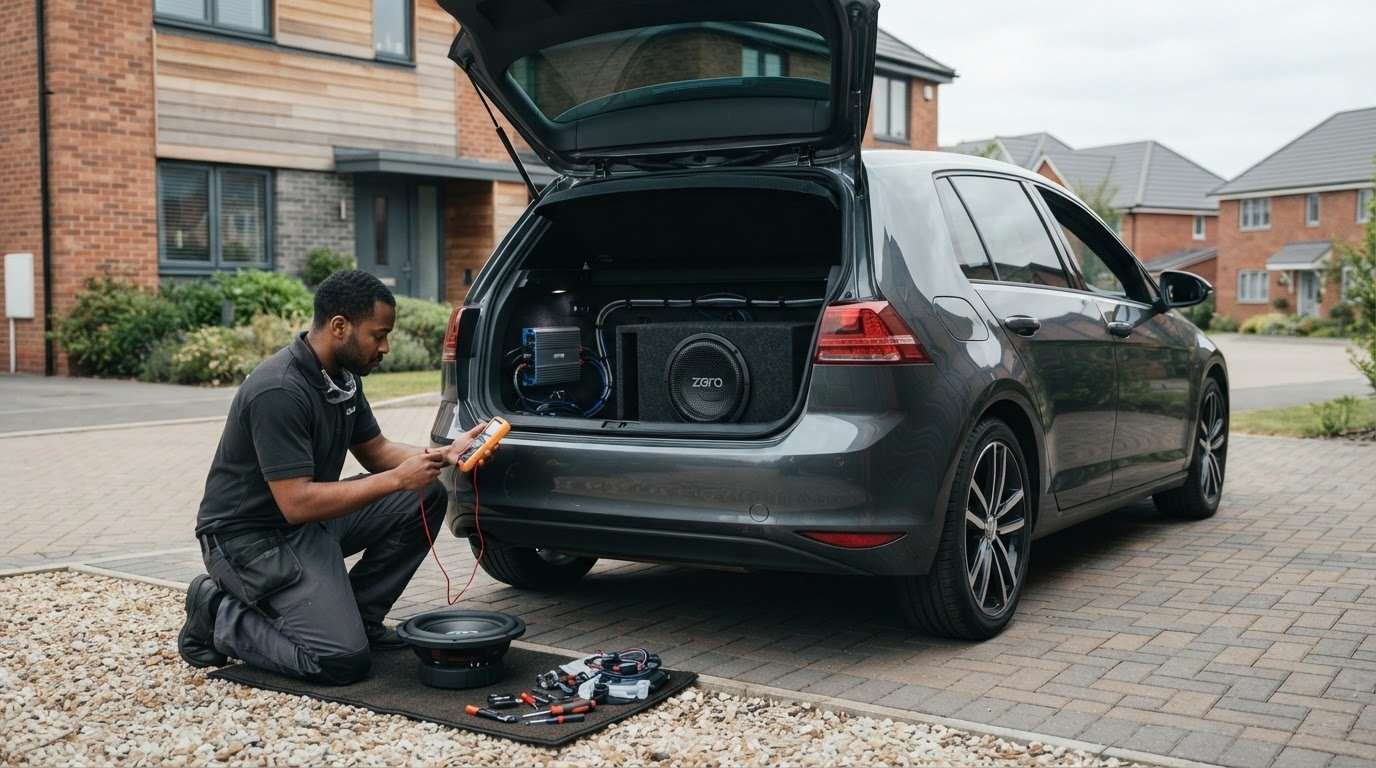
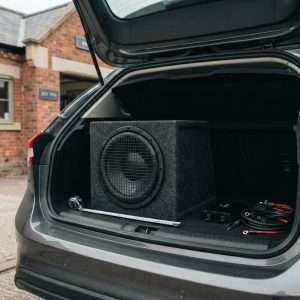
Measure the area where the enclosure could be installed, including height, depth and access. Consider the parcel shelf, folding seats, spare wheel and any equipment beneath the boot floor. A box that fits the empty boot may still interfere with daily use.
Compact and under-seat arrangements can be useful where luggage space matters, but suitability depends on the actual unit and vehicle. Do not assume an under-seat product will clear seat movement, ventilation outlets or existing wiring.
Larger car subwoofers generally need more installation space once their enclosure is included. The speaker diameter alone does not tell you the final footprint. Ask for the dimensions of the complete proposed installation.
Plan around normal journeys
If you carry a pushchair, tools or regular luggage, tell the installer before choosing the enclosure. Ask how the equipment will be protected from moving items and how access to essential vehicle equipment will be retained.
A removable arrangement, where appropriate, needs suitable connections and secure mounting. It should not leave exposed live terminals or loose equipment when disconnected. Agree the design professionally rather than improvising a way to lift the box out.
3. Understand active and passive options
An active subwoofer combines a speaker with a built-in amplifier. A passive subwoofer needs a separate suitable amplifier. Neither layout is automatically better; the right choice depends on the desired output, available space and wider system.
Active car subwoofers can simplify equipment selection, but they still need correct power, signal and mounting arrangements. Passive setups offer flexibility in matching components, with more decisions about amplifier capability and wiring.
| Option | What to consider |
|---|---|
| Active unit | Complete dimensions, built-in amplifier, input compatibility and power supply |
| Passive subwoofer | Suitable enclosure, separate amplifier and connected speaker load |
| Compact installation | Available clearance, ventilation and realistic performance expectations |
| Boot enclosure | Luggage access, secure mounting and protection from moving items |
Browse the car subwoofer range with these practical requirements in mind. Confirm the exact product and proposed fit before ordering.
4. Match car subwoofers to suitable enclosures
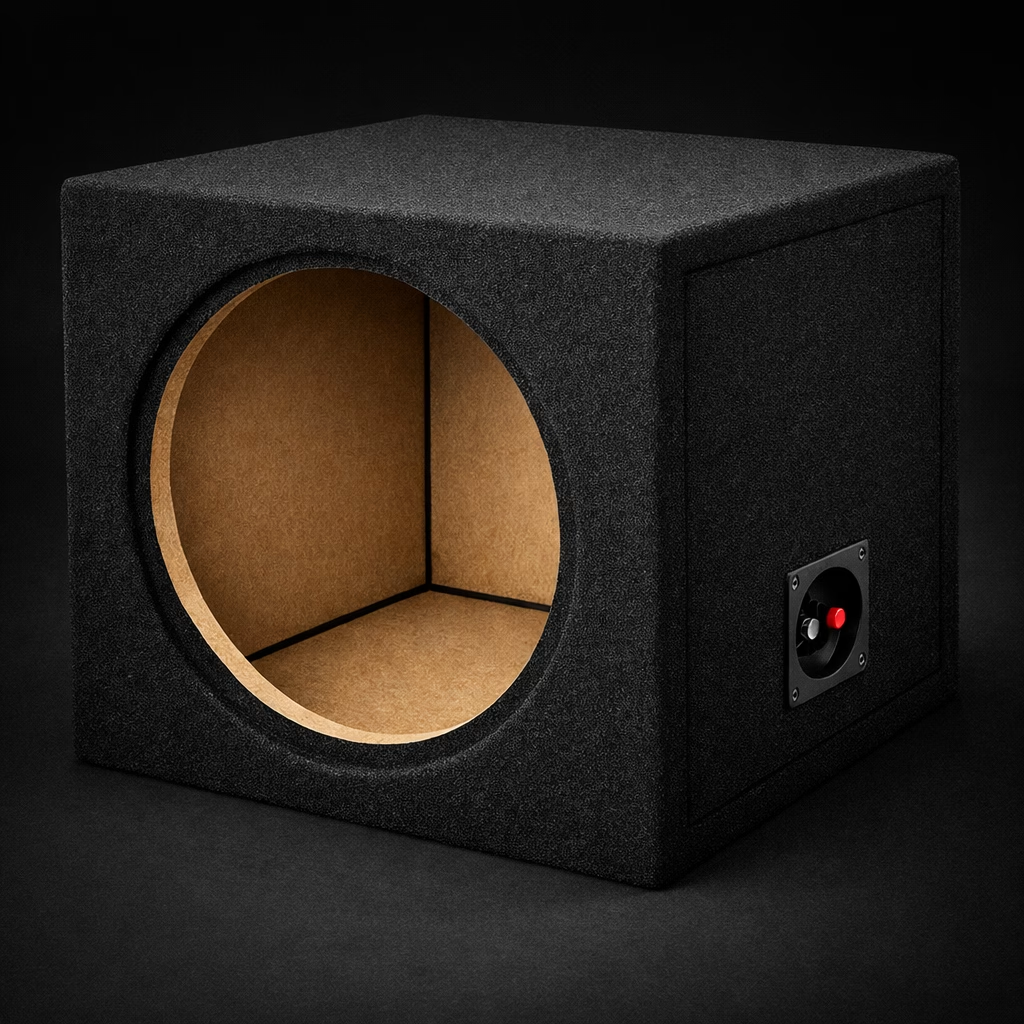
The enclosure is part of the acoustic design. A sealed box and a ported box are different arrangements, and each needs to suit the specific speaker. Internal volume, construction and any port dimensions matter.
Do not choose an enclosure solely because its speaker cut-out has the right diameter. Two car subwoofers of the same diameter may have different enclosure recommendations. Use the manufacturer’s instructions for the exact model.
For example, the official Rockford Fosgate Prime R1 subwoofer installation manual gives model-specific enclosure and wiring information. It is useful manufacturer guidance, but its dimensions and limits should not be copied onto a different product.
Why installation details matter
An enclosure must be securely mounted so it cannot become a hazard. The installation also needs to allow for cables, connections and amplifier cooling. A neat-looking box is not enough if the mounting or electrical work is unsuitable.
Ask the installer to explain the proposed position and any effect on storage. Do not drill through the vehicle floor yourself without knowing what is behind it. Vehicle structures, wiring and other systems need to be considered.

5. Match power and impedance correctly
Power specifications need to be compared on a like-for-like basis. Continuous or RMS ratings and peak figures describe different things. A larger peak number on a box does not by itself establish that a product will sound better.
Impedance, measured in ohms, describes the speaker load presented to the amplifier. The final connected load must be within the amplifier’s permitted specification. Wiring multiple speakers or dual voice coils can change that load.
Car subwoofers and amplifiers should therefore be selected together. Bridged amplifier operation may have different limits from ordinary channel use. Ask the installer to confirm the actual wiring arrangement rather than relying on a general rule.
Compare suitable car audio amplifiers with the chosen speaker and enclosure. Avoid buying components separately without checking how the full system will operate.
Gain is not an extra volume control
Gain is used to match input sensitivity to the source signal. Unsuitable gain or bass-boost settings can create distortion. An installer should set up the system as a whole and demonstrate its ordinary user controls.
If car subwoofers stop playing, distort or cause the amplifier to shut down, reduce the level and arrange investigation. Repeated high-volume testing is not a useful repair method.
6. Check factory-system integration
Modern factory audio can include a separate amplifier, sound processing or vehicle-specific speaker arrangements. Tell the installer about the factory specification and any previous modifications.
Ask how the bass signal will be obtained and whether suitable interfaces are required. A product accepting a particular input type does not prove it can be connected correctly to every vehicle. Compatibility needs checking for the actual equipment.
Car subwoofers should integrate with the rest of the sound, including level and crossover settings. A crossover controls which frequencies are sent to a speaker. Correct setup helps the subwoofer and main speakers work together.
Consider the main speakers too
If a wider upgrade is appropriate, compare vehicle speakers against the same listening goals. Replacing every component is not always necessary, but weak or damaged speakers should not be ignored.
Explain which original functions you want to keep, such as steering-wheel controls and parking information. Ask for confirmation of the proposed arrangement before installation rather than discovering a lost function at handover.
7. Arrange safe fitting and a clear handover
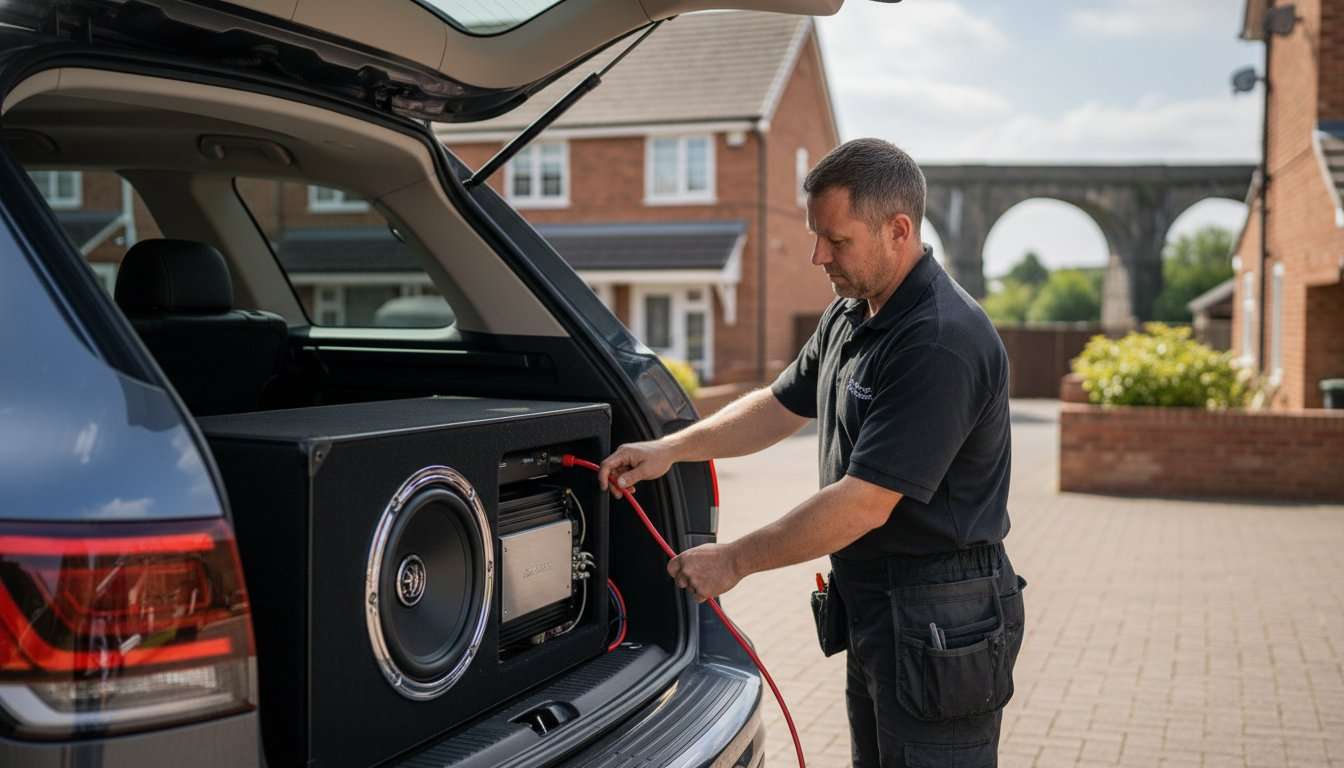
Car subwoofers need appropriate wiring, circuit protection and secure mounting. Cable selection depends on the actual current demand, length and installation conditions. There is no single cable or fuse size suitable for every system.
Never bypass a fuse or increase its rating to stop it blowing. Stop using equipment with smoke, a burning smell or visible heat damage and arrange inspection. Electrical changes should follow the product and vehicle requirements.
Safe & Sound Mobile supplies and installs car audio with nationwide mobile fitting. Provide the vehicle details, existing audio specification and available space so the team can discuss a suitable installation.
Before the appointment
- List the equipment already fitted.
- Describe your listening goals and preferred music.
- Explain luggage and spare-wheel access needs.
- Ask for a written list of parts and fitting work.
- Confirm compatibility and support arrangements.
- Request a demonstration at sensible listening levels.
Keep the invoice, model details and operating instructions. Ask which setup controls should be left as adjusted and how to report a fault. A clear handover makes car subwoofers easier to live with.
Frequently asked questions
Are bigger car subwoofers always better?
No. The enclosure, amplifier, installation and vehicle matter alongside speaker size.
Can I retain my factory head unit?
Often an installation can be planned around it, but compatibility and any required interfaces need confirmation.
Does an active unit still need professional wiring?
It still needs a suitable power supply, signal connection and mounting. Professional fitting is advisable where you lack the relevant experience.
Is a ported enclosure always louder?
Results depend on the complete design and operating conditions. Follow the exact speaker’s enclosure recommendations.
Can the box be left loose in the boot?
No. Equipment must be secured appropriately so it cannot move dangerously.
Can fitting take place at home?
Safe & Sound Mobile offers nationwide mobile fitting; confirm the location and appointment requirements with the team.
Choose better bass around your vehicle
Car subwoofers work best when the speaker, enclosure and amplifier are matched to the vehicle and your listening goals. Measure the space, check compatibility and arrange safe installation rather than choosing on wattage alone.
Contact Safe & Sound Mobile about a subwoofer upgrade with your vehicle and current audio details. The team can help you plan a system that fits your car and everyday use.


About author
Related posts

Car Amplifier Cutting Out? 7 Common Causes and Safe Checks A car amplifier cutting out usually points to overheating, a power supply problem, an unsuitable... Continue reading

Vauxhall vehicle security should match your car, your insurance policy and your daily routine. Safe and Sound Mobile helps UK owners compare immobilisers, monitored trackers,... Continue reading

Skoda vehicle security works best when protection is chosen for your exact car and the way you use it. Whether you drive an Octavia estate,... Continue reading
“Direct fit” doesn’t mean “fits every Ford”. If you’re searching for Powebass Ford Oem Direct Fit speakers, match the product to your exact vehicle,... Continue reading
Will a Powerbass loaded enclosure fit your car and work with the stereo and amplifier you already have? A box can look right but take... Continue reading