
No products in the cart.
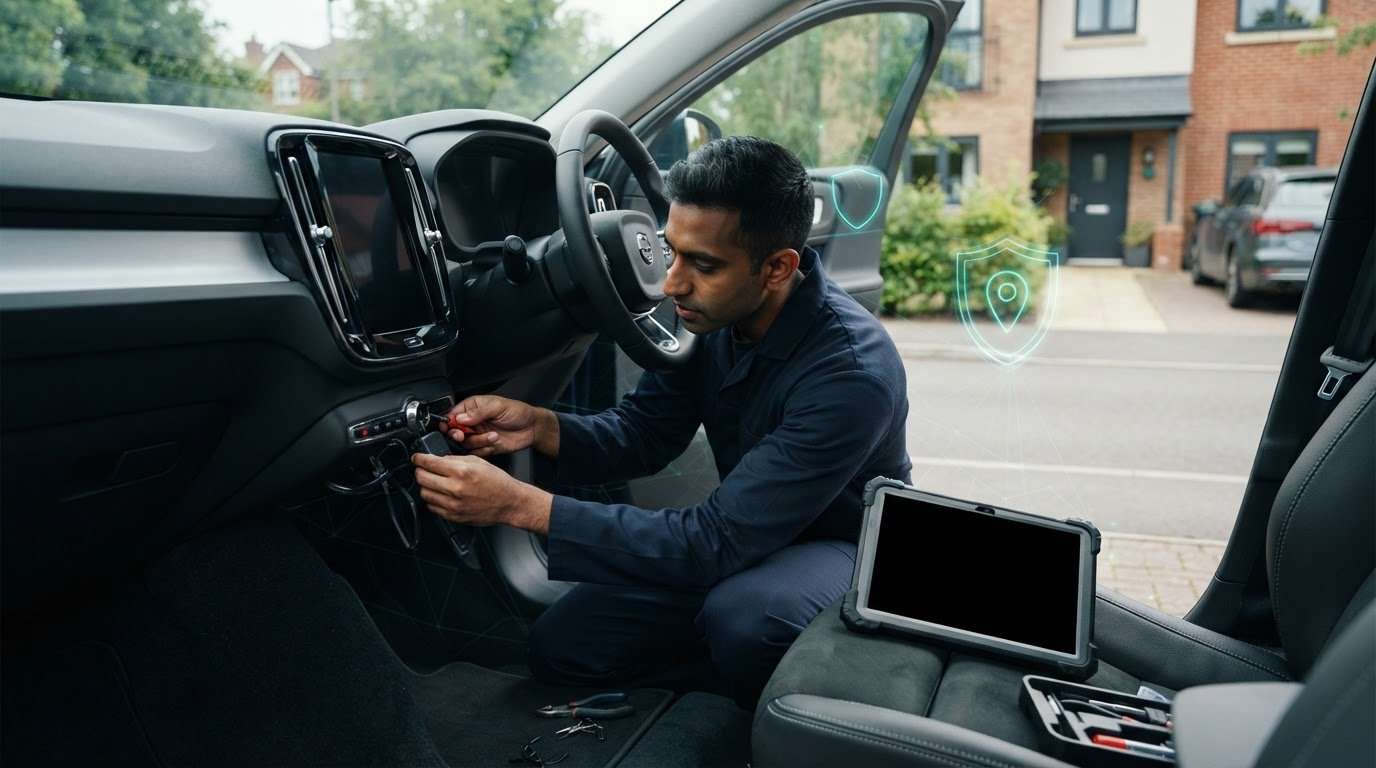
Car tracker fitting prices in the UK for insurance-approved systems
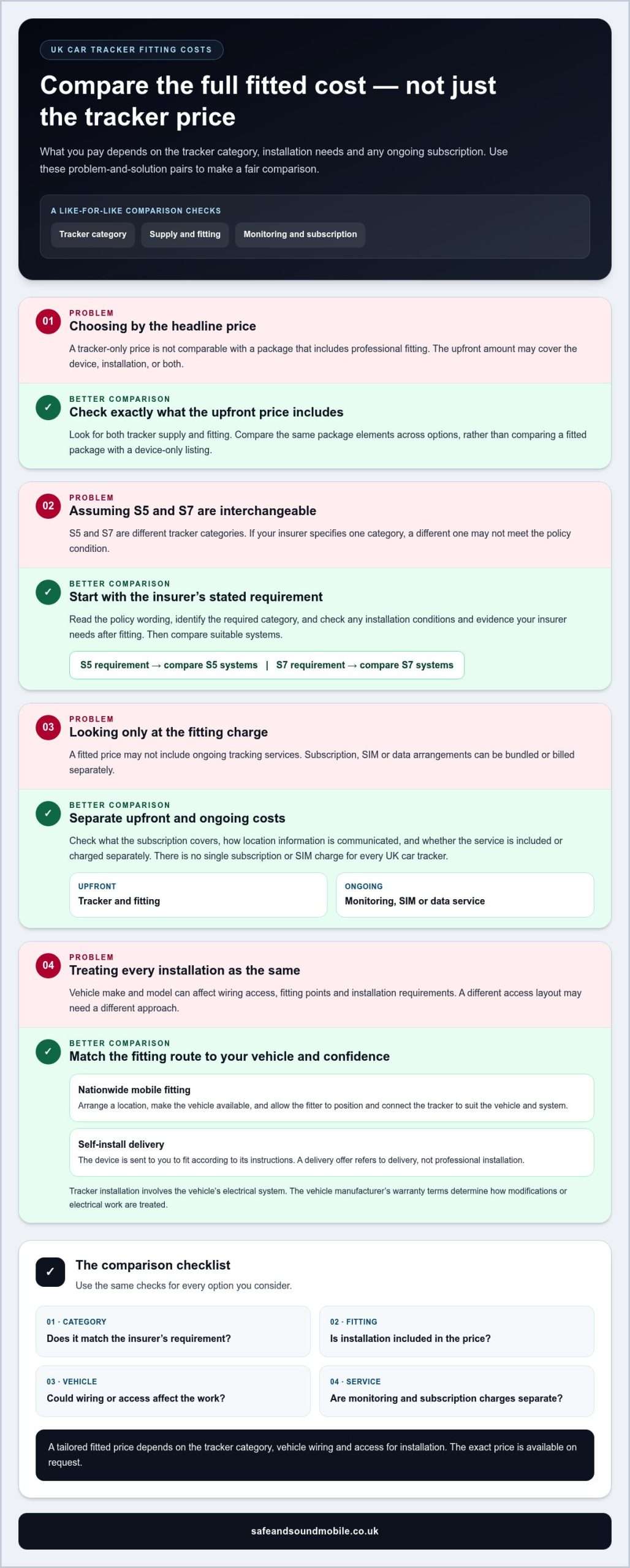
A lower tracker price doesn’t always mean a lower fitted cost. The car tracker fitting cost in the UK depends on the tracker category, installation requirements and any ongoing subscription. S5 and S7 systems can differ in price, so the right comparison starts with your vehicle’s security needs and your insurer’s requirements.
It’s sensible to look beyond the initial fitting charge. Some insurers require an approved tracker for certain vehicles, while added security can support vehicle recovery if a car is stolen. Choose a system that meets your insurer’s requirement and suits how you use your vehicle.
This guide explains what can affect fitted tracker prices, how S5 and S7 systems compare, and what to consider about subscriptions and security benefits. You’ll also find out how mobile fitting works, so you can make a more informed choice before arranging an installation.
Key Takeaways
- Compare the full fitted cost, not just the tracker price; installation and any ongoing subscription can affect your total spend.
- S5 and S7 trackers have different fitted price points, so match the category to your vehicle’s security needs and insurance requirements.
- Check what your insurer requires before choosing a system, as some policies may specify an approved tracker for certain vehicles.
- Understand what Thatcham approval means so you can compare tracker standards and make a more informed choice.
- Consider how tracking can support vehicle security, including helping to locate a car if it’s stolen.
How much do insurance-approved trackers cost?
The fitted cost depends on the tracker, the vehicle and what the installation includes. Compare the device, fitting and monitoring arrangements separately to understand the full package.
Upfront Tracker and Fitting Costs
The upfront cost of an insurance-approved tracker may cover the device, fitting, or both. Read the package details to see whether installation is included, then compare the tracker category and the work required for your vehicle.
Make a like-for-like comparison. A tracker-only price, for example, is not comparable with a fitted package. The vehicle’s make and model can affect installation requirements because wiring access and fitting points vary.
Installation-Included Tracker Prices
Some tracker packages include UK installation, while others list the device and fitting separately. Check what the price covers so you can tell whether it includes both.
Also check what the package includes for monitoring and subscriptions. A fitted price may cover installation but not ongoing tracking services. Compare the complete arrangement, rather than judging by the device price alone.
Nationwide Fitting and Self-Install Delivery
With nationwide mobile fitting, the installation process typically involves arranging a location, making the vehicle available and allowing the fitter to install the device. The installer positions and connects the tracker in a way suited to the vehicle and system.
Self-install trackers work differently: the device is sent to you for fitting according to its instructions. A seller’s next-day delivery offer refers to delivery, not professional installation. Compare the fitting requirements and choose an option that suits your confidence with vehicle equipment.
Subscriptions and SIM Charges
There is no single subscription or SIM charge for every UK car tracker. Ongoing costs depend on the monitoring service, SIM or data arrangement and subscription term. Before comparing packages, check whether these are bundled or billed separately.
Check what the subscription covers, including how the system communicates location information. The tracker’s upfront cost and ongoing service are separate parts of vehicle security, so consider both when planning your spending.
For a fitted insurance-approved system, the price depends on the tracker category, vehicle wiring and access for installation. The exact price is available on request.
The vehicle’s make and model can affect fitting time and installation requirements. A model with different wiring access may need a different installation approach.
Tracker installation involves connecting equipment to the vehicle’s electrical system, so the fitting must suit the car’s wiring. The vehicle manufacturer’s warranty terms determine how modifications or electrical work are treated.
Fitted prices for Thatcham S5 and S7 trackers
Thatcham S5 and S7 trackers are different categories of insurance-approved vehicle security. Their fitted prices depend on the system selected and the work needed for the specific car. Compare a complete fitted package, not just a device listing, so you can see what the upfront amount covers.
The category matters most when an insurer has specified a tracker type for a vehicle. Check the policy wording first, then match the required category to the fitted system. An S5 price and an S7 price are not interchangeable if the insurer requires one particular category. The driver’s next step is to confirm the requirement before comparing options.
A tracker purchase price may cover the hardware alone. A fully fitted price should make clear whether installation is included, and whether any monitoring subscription is separate. For example, compare two S7 listings by checking the same items in each: tracker, fitting and ongoing service. This makes the difference between a device-only offer and a fitted package easier to judge.
Meta Trak and ScorpionTrack are names you may encounter when comparing systems. Focus on the required category, whether installation is included and any subscription terms, rather than choosing by brand name alone. Advanced features can affect a system’s price, but the insurer’s specified category is the practical starting point.
To compare S5 and S7 fitted prices, use this simple sequence:
- Read the insurance requirement and identify the tracker category.
- Check whether the advertised amount includes supply and fitting.
- Separate upfront installation costs from monitoring or subscription charges.
- Compare the same package elements across each option.
This process helps avoid comparing an S5 fitted package with an S7 device-only price. It also makes clear which costs relate to installation and which continue after fitting. If the vehicle’s wiring or access affects the installation, that work can influence the final quote.
For a tailored comparison, review insurance-approved tracker options against the category your insurer requires. A quote for your vehicle should reflect the tracker type, fitting needs and package inclusions, rather than relying on a headline device price.
Insurance requirements and potential premium effects
For some high-value or high-risk vehicles in the UK, an approved tracker may be required to obtain insurance. The specific category matters: if a policy requires an S5 system, an S7 tracker may not meet that condition. Check the policy wording before choosing a device or arranging fitting.
Thatcham Research is the UK’s motor insurance research body. Its name is associated with vehicle security categories, but your insurer’s stated requirement is the key guide. Check the required category, any installation conditions and what evidence your insurer needs after fitting.
“Insurance-approved” and “Thatcham-approved” are often used when discussing trackers, but don’t rely on a label alone. Match the exact tracker category to the policy. For example, if the insurer specifies an S5 tracker, compare S5 options and confirm that the fitted device meets that requirement. The same approach applies when the policy specifies S7.
Could a tracker reduce your premium? Some UK insurers may offer a discount when an approved tracking system is fitted. Any reduction depends on the insurer’s policy and assessment of the vehicle. Treat it as a possible benefit, not the main reason to choose a tracker.
Before arranging installation, follow these steps to clarify your insurance requirement:
- Read the policy or insurance requirement for the exact S5 or S7 category.
- Check that the proposed device matches that category.
- Ask what installation evidence the insurer needs, such as confirmation of the fitted system.
- Tell the insurer when the tracker has been installed, following its stated process.
These steps help align the tracker, fitting and insurance record. Plan a mobile installation appointment around the vehicle’s availability, and choose a system that meets the category specified by your insurer. Keep the installation details with your policy documents.
Features such as driver recognition or mobile alerts shouldn’t replace the insurer’s stated category. Focus first on whether the system meets the required S5 or S7 condition. Then consider any additional functions as part of your wider vehicle security decision, rather than assuming they affect insurance recognition or premium calculations.
If your insurance requires a tracker, start with the approved category, then confirm suitable fitting and any documentation your insurer requires. A possible discount may affect the overall cost, but meeting the policy requirement comes first.
Thatcham-approved vehicle trackers
A Thatcham-approved vehicle tracker has passed testing and meets performance and reliability standards set by Thatcham Research, the UK’s automotive security authority. That approval gives drivers a recognised basis for comparing vehicle tracking systems, but the category still matters. S5 and S7 identify different tracker categories, so choose the one that matches your insurer’s requirement.
Approval is not simply a general label for any device that can show a vehicle’s location. A system should meet the relevant Thatcham category’s standards to be described as approved for that category. If an insurer names S5, for example, compare S5 systems rather than assuming an S7 device is equivalent. Check the exact category in your policy before buying or arranging fitting.
Thatcham Research’s standards assess a tracker’s performance and reliability. This helps distinguish an approved vehicle tracking system from a device chosen only for basic location features. A tracker can support recovery if a car is stolen, but approval refers to the device’s tested standard, not a guaranteed recovery outcome.
Tracking and immobilisation serve different security purposes. A tracker helps identify a vehicle’s location, while an immobiliser is designed to prevent or restrict engine starting. Don’t assume a Thatcham-approved tracker includes immobilisation. If you want both functions, compare the tracker and immobiliser as separate parts of your security setup.
Use these steps to choose the relevant category:
- Read the insurer’s wording and note whether it requires S5 or S7.
- Match the tracker’s stated approval category to that requirement.
- Compare the fitted system and installation details, not just the device name.
- Keep the installation record and tracker details with your insurance documents.
These checks help ensure the tracker matches your policy. An authorised fitter can install the selected system, while your insurer’s requirement determines the category to choose. Keep the tracker’s model and category details available in case your insurer asks for evidence of the fitted device.
For example, a driver whose policy specifies S5 should focus on S5-approved systems and fitting arrangements. A driver with an S7 requirement should compare S7 options instead. In either case, verify that the wording refers to the tracker’s category, not merely to a broad description such as “vehicle security”.
A Thatcham-approved tracker can form part of a considered security plan, alongside careful attention to the insurer’s category requirement. Choose the required S5 or S7 system first, then compare its fitting and any separate security functions.
Tracker benefits and vehicle security
A vehicle tracking system adds a recovery tool to your wider security plan. A GPS tracker can show a vehicle’s location in real time, helping you establish where it is if stolen. This information can help you locate the vehicle and inform the relevant authorities of its whereabouts.
The need is tangible. QuestGates analysis of DVLA figures counted 53,629 private cars stolen in the UK in 2025, with a 44.94 percent recovery rate across stolen vehicles that year. A tracker cannot prevent every theft or guarantee recovery, but location information can provide a useful lead after a vehicle goes missing.
An approved car tracker can also connect to a secure control centre through a subscription. Some tracking subscriptions may include 24/7 monitoring, which can support a response when a theft is reported. Check what the subscription covers: the device, the fitting and the monitoring service are distinct parts of the overall arrangement.
Vehicle tracking can also support businesses. Tracking systems can help monitor employee vehicles, deliveries, mileage and driver locations. For example, location information can show where a delivery vehicle is along its route. The system’s usefulness depends on its purpose and the service attached to it.
Consider these practical points before choosing a system:
- Recovery support: A tracker can provide location information to help find a stolen vehicle.
- Monitoring: Subscription terms determine whether a secure control centre and 24/7 monitoring are included.
- Vehicle use: A private car and a business delivery vehicle may need different tracking functions.
- Approval: If insurance requires an approved category, match the tracker to that requirement.
Nationwide mobile fitting is useful when you want a tracker installed at your location rather than travelling to an installer. Professional fitting is also a practical option when the system connects to vehicle wiring. The installation needs to suit both the vehicle and the tracker.
Be clear about your purpose. If theft recovery is the priority, focus on location tracking and the monitoring arrangement. For a business fleet, consider how tracking could support deliveries, mileage records or driver locations. These needs are a better guide than features that don’t serve your use case.
For a vehicle security system suited to your needs, explore professional tracker fitting.
Safe & Sound Mobile: Insurance Approved Vehicle Trackers
Safe & Sound Mobile supplies and professionally fits insurance-approved vehicle trackers, including Thatcham S5 and S7 systems. Its mobile installation service brings fitting to your location across the UK, making it a practical next step when your insurer requires an approved tracker or you want a professionally installed system.
Choose the tracker category that matches your insurance requirement, then consider whether an immobiliser would complement your security setup. Safe & Sound Mobile also supplies car audio systems and dash cams, with options to suit different vehicle needs.
For details about suitable tracker fitting, visit Safe & Sound Mobile.
Choose a security setup that fits your next step
Treat car tracker fitting cost in the UK as one part of your decision, not the only one. Start with your vehicle’s security requirements, then consider how you want the system fitted and whether you’re planning additional protection. Clear priorities make it easier to choose equipment that suits your needs.
Safe & Sound Mobile supplies and installs Insurance Approved Vehicle Trackers and Vehicle Immobilisers, as well as Car Audio Systems. The tracker installation price depends on the vehicle, selected system and fitting requirements, and is available on request.
Take the next step with your vehicle’s requirements in mind. Contact Safe & Sound Mobile to discuss an insurance-approved tracker and fitting for your vehicle. A considered choice can help you move forward with confidence.
Frequently Asked Questions
How much is a car tracker?
The total depends on whether you’re buying a device alone or a fitted system. A device-only listing won’t show the full cost if professional installation and an ongoing subscription are separate. Compare what each option includes, such as fitting, monitoring and SIM services. For an insurance-approved tracker, check that the category matches your policy. This gives you a more useful comparison than considering the hardware alone.
Car Trackers: How Do I Arrange My Car Tracker Installation or Delivery?
Decide whether you want mobile fitting or a tracker delivered for self-installation. For mobile fitting, have your vehicle details and location ready when arranging the appointment. Safe & Sound Mobile provides mobile installation across the UK, at home or work. If you’re considering delivery for self-installation, check the product instructions and what the delivery option includes. Choose the route that suits your vehicle and confidence with fitting.
How long does the installation take?
Installation time depends on the tracker and the vehicle’s layout. Wiring access and the chosen mounting position can affect the work involved. Before the appointment, make the vehicle available and clear belongings that block access to the dashboard or other fitting areas. This allows the installer to complete the fitting and check that the system operates as intended. Avoid planning other commitments around an assumed installation duration.
Choose a tracker for location and recovery support, and consider an immobiliser if preventing unauthorised engine starting is also a priority. They serve different security purposes, so one does not automatically replace the other. Check your insurer’s requirement first, then decide whether immobilisation suits your needs. Compare the system components and fitting details rather than assuming a price difference means the protection is equivalent.
How much does it cost to fit a car tracker in the UK?
The car tracker fitting cost in the UK depends on the tracker category, the vehicle and the installation work. A quote should distinguish the fitted system from ongoing subscription or monitoring charges. For an insurance-approved installation, the required S5 or S7 category can also shape the choice. Prepare your vehicle make and model, location and insurer’s tracker requirement so the quoted work can reflect the setup you need.
What is the average UK price for a professionally installed GPS car tracker?
There is no useful average for every professionally installed GPS tracker because packages differ in hardware, fitting and service arrangements. A device-only option and an insurance-approved fitted system are not like-for-like. To assess a quote, check whether it includes installation and monitoring, and whether a subscription continues after fitting. The vehicle’s wiring and access can also affect the installation work.
Do UK car insurance companies offer discounts for fitted car trackers?
Some UK insurers may offer a premium discount when an approved tracking system is fitted. The insurer’s terms determine whether a discount applies and which tracker category it recognises. Keep the tracker category and installation details with your policy documents, and refer to them when reviewing your cover at renewal. Treat any possible saving separately from the tracker’s security role, rather than assuming it will offset the installation cost.
Can a car tracker be fitted at home, and how much does mobile installation cost?
Yes, a mobile fitter can install a tracker at home or work, provided the vehicle is accessible. Safe & Sound Mobile offers mobile installation across the UK. The fitting price depends on the tracker, vehicle and installation requirements, and is available on request. Have the vehicle’s make and model, along with the required insurance category, ready when arranging the fitting.
About author
Related posts

The Ultimate 3-Channel Dash Cam Review & UK Fitting Guide 2026 What if your current dash cam misses the exact side-impact or rear-end nudge that... Continue reading

2026 Price Guide Ensuring your vehicle is fully compliant extends beyond just informing your insurer; it also involves passing annual roadworthiness... Continue reading

In recent years, the use of vehicle trackers and telematics systems by insurance providers has become increasingly widespread across the UK. With car insurance costs... Continue reading

Vehicle theft in the UK has changed a lot over the past decade. Thieves have become more advanced, using smart technology to steal cars faster... Continue reading

Cat 5 Tracker In the modern automotive landscape, technology powers nearly every vehicle function, from engine performance to connectivity and security. As a result, technical... Continue reading