
No products in the cart.

Car Audio Upgrades: Beginner’s Guide | Safe & Sound Mobile
A Beginner’s Guide to Better Sound
Does a flat, lifeless factory stereo soundtrack your daily commute? The world of car audio upgrades promises crystal-clear highs and deep, resonant bass, but a wall of technical jargon often guards it. Terms like ‘ohms’, ‘DIN sizes’, and ‘RMS watts’ can make the entire process feel overwhelming, creating uncertainty about which components are compatible with your vehicle and whether a DIY installation is a risk worth taking.
This guide is designed to cut through that complexity. We provide a straightforward roadmap for beginners, demystifying every part of your sound system, from the head unit to the subwoofer. You will learn precisely what you need to achieve your goals, whether that’s adding modern features like Apple CarPlay or building a system with concert-level quality. Gain the confidence to select the right equipment and understand the importance of professional installation for a flawless, superior listening experience.
Why Upgrade Your Factory Car Audio System?
Most vehicles leave the factory with a standard audio system designed to meet a budget, not to deliver a premium listening experience. While the history of vehicle audio shows remarkable progress from simple AM radios, manufacturers often compromise on sound quality. The result is often underwhelming: a flat, lifeless sound that lacks clarity and depth. Upgrading your factory car audio system is the definitive solution to unlock the true potential of your in-car entertainment.
An aftermarket system provides a vastly more immersive and dynamic experience, replacing weak components with high-performance equipment engineered for superior audio fidelity. It is an investment in both your driving pleasure and your vehicle’s functionality.
The Difference You Can Actually Hear
The primary limitation of a factory setup is its reliance on low-quality components. Standard speakers typically use thin paper cones that distort easily and fail to reproduce sound accurately. Aftermarket speakers, engineered with superior materials like polypropylene or silk composites, deliver far greater clarity, richer mid-tones, and tighter bass. Furthermore, the built-in amplifier in a standard head unit is severely underpowered, distorting at higher volumes. A dedicated amplifier provides clean, consistent power, allowing you to enjoy your music at any level without compromising fidelity. A professional car audio upgrade reveals details in songs you have never heard before.
Beyond Sound: Upgrading for Features and Connectivity
A modern audio upgrade is about more than just superior sound. It transforms your vehicle’s dashboard into a connected, intelligent hub that enhances both convenience and safety. By replacing the factory head unit, you gain access to essential technologies that are often missing from standard or older models. Key benefits include:
Seamless Smartphone Integration: Use Apple CarPlay and Android Auto to safely access maps, music, podcasts, and messages directly from your dashboard.
Enhanced Connectivity: Enjoy high-fidelity Bluetooth audio streaming and crystal-clear, hands-free calling for improved safety on the road.
Advanced Navigation: Benefit from larger, high-resolution touchscreens that deliver a clearer, more responsive navigation experience.
Improved Vehicle Safety: Integrate essential safety features such as reversing cameras and parking sensors, which display directly on your new screen.
The Core Components of a Car Audio System Explained
Think of your car audio system as a high-performance band. For an exceptional sound experience, every member must work in perfect harmony. The head unit is the band leader, the speakers are the vocalists, the amplifier is the powerhouse, and the subwoofer provides the deep, rhythmic heartbeat. While these components deliver the best results together, upgrading even a single one can produce a significant and noticeable improvement in sound quality.
The Head Unit: The Brain of Your System
The head unit, or car stereo, is the source and control centre of your entire system. It manages audio sources like radio, Bluetooth, and USB input, and provides the user interface for all adjustments. Understanding your vehicle’s dashboard is key; it will accept either a single-DIN (smaller, rectangular unit) or double-DIN (larger, often with a touchscreen) size. When upgrading, look for essential features that match your needs.
Connectivity: Bluetooth, Apple CarPlay, and Android Auto are now standard for seamless phone integration.
Screen: A responsive, high-resolution touchscreen improves user experience.
Pre-outs: These outputs are essential for connecting external amplifiers to power your speakers and subwoofer.
Speakers: The Voice of Your System
Speaker Fitment Terms That Matter
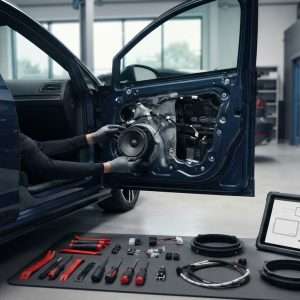
Before buying replacement speakers, confirm four details: diameter, mounting depth, impedance and sensitivity. Diameter and mounting depth determine whether the speaker physically fits behind the door card. Impedance is the electrical load presented to the amplifier, while sensitivity indicates how efficiently a speaker produces sound from available power. High-sensitivity speakers are often a practical choice when retaining a factory head unit.
- Mounting depth: Check clearance behind the speaker, including windows, wiring and factory brackets.
- Impedance: Use speakers compatible with the head unit or amplifier that will power them.
- Sensitivity: A more efficient speaker can deliver stronger output from modest factory power.
- Component or coaxial design: Choose coaxials for simpler replacement fitting, or components when separate tweeter placement and sound staging are priorities.
Speakers are the transducers that convert electrical signals from your amplifier into the sound you hear. A direct replacement of factory speakers is often the most impactful first upgrade. There are two main types: coaxial speakers are an all-in-one design, making them a simple and effective upgrade. Component speakers separate the tweeter (high-frequency) and mid-range driver for superior sound staging and clarity. Matching the speaker size to your vehicle’s factory locations is critical for a correct and secure installation.
The Amplifier: The Powerhouse
An amplifier takes the low-level audio signal from your head unit and boosts it with clean, stable power. This is essential for driving high-quality aftermarket speakers and subwoofers, allowing for loud, clear sound without distortion. Always prioritise the RMS (continuous) power rating over the misleading Peak Power figure. Amplifiers come in different configurations: monoblock amps are designed specifically to power subwoofers, while multi-channel amps (2, 4, or 5-channel) power your main speakers.
The Subwoofer: The Heartbeat
Choosing the Right Subwoofer Enclosure
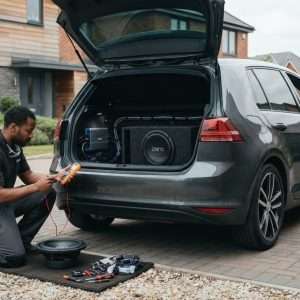
The enclosure has a major effect on how a subwoofer sounds and how much vehicle space it uses. Sealed enclosures are commonly chosen for controlled, accurate bass, while ported enclosures are suited to listeners who want more output. Under-seat subwoofers preserve boot space but cannot usually deliver the same low-frequency impact as a larger, correctly powered boot enclosure.
A subwoofer is a specialised speaker designed solely to reproduce low-frequency sounds-the bass you can feel. Factory car audio systems cannot typically produce deep, impactful bass, leaving music sounding thin. Subwoofers correct this. They come in various enclosures, with sealed boxes offering tight, accurate bass and ported boxes delivering louder output. From compact under-seat models that save space to large boot enclosures for maximum impact, there is a solution for every vehicle and listener.
Planning Your Upgrade: A Step-by-Step Approach
A successful car audio upgrade begins long before any equipment is purchased. A clear plan prevents costly mistakes and ensures the final result meets your expectations. Whether you intend a complete system overhaul or a phased upgrade over time, this structured approach provides the necessary foundation for success.
Step 1: Define Your Audio Goals
Choose an Upgrade Path for How You Use Your Car
- Family car: Prioritise clear hands-free calls, navigation, reliable Bluetooth and balanced sound at normal listening volumes.
- Lease or finance vehicle: Choose non-destructive, reversible fitting methods and retain all original parts for reinstatement.
- Older or used car: Start with condition and fitment checks, then consider speakers or a head unit to add modern connectivity.
- Keep the factory dashboard: Retain the original head unit and improve the signal path with suitable integration equipment, amplification and speakers.
- Bass-first listening: Plan space, amplification, power requirements and enclosure type before selecting a subwoofer.
- Commuting and calls: Focus on smartphone integration, microphone quality and speaker clarity before pursuing maximum volume.
First, determine what you want to achieve. Your listening habits and priorities will dictate the best components for your system. Ask yourself:
What is my primary goal? Are you seeking powerful, deep bass, crystal-clear vocal clarity for podcasts, or extreme loudness?
What kind of listener am I? A ‘Commuter’ may prioritise Bluetooth connectivity and call quality, while an ‘Audiophile’ will focus on high-fidelity sound reproduction and source quality.
Do I need modern features? Is integrating Apple CarPlay or Android Auto a key requirement for navigation and media control?
The type of music you enjoy most will also influence your choices, from speaker materials to the need for a dedicated subwoofer.
Step 2: Set a Realistic Budget
Allow for Electrical and Installation Requirements
Budgeting for a higher-power system should include the supporting installation work, not only the visible audio equipment. Amplifiers need correctly sized power and earth cables, a fuse positioned close to the battery and secure cable routing that avoids heat, moving parts and damage. If a proposed system places unusually high demand on the vehicle’s charging system, a professional should assess the battery and alternator before installation.
- Warning signs: Headlights dimming noticeably with bass notes, repeated amplifier protection mode, battery warnings or electrical faults should be investigated rather than ignored.
- Safe expectation: A correctly specified everyday upgrade should operate normally while the engine is running; avoid listening for long periods with the engine switched off.
Your budget will be the single biggest factor in narrowing down your options. It is critical to account for both the equipment and professional installation costs. A poorly installed system will not perform to its potential.
Consider these general budget ranges (including fitting):
£250 – £500: Entry-level upgrades, typically focusing on a new head unit or a front speaker replacement for a significant improvement over factory sound.
£750 – £1250: A comprehensive upgrade including speakers, a head unit, and a small amplifier or subwoofer for a full-range sound experience.
£1500+: High-performance systems for audiophiles, featuring premium components, sound deadening, and expert tuning for ultimate fidelity.
For the biggest initial impact, allocate your funds to speakers and a quality head unit first. We also offer 0% finance options to help spread the cost of your ideal system.
Step 3: Check Vehicle Compatibility
Keeping Factory Infotainment vs Replacing the Head Unit
You do not always need to replace the factory head unit to improve car audio. Where the original screen controls climate settings, parking information or other vehicle functions, retaining it may be the better option. A suitable line-output converter, signal processor or vehicle-specific plug-and-play amplifier solution can take the factory audio signal to aftermarket amplification and speakers while keeping the original dashboard functions in place.
Compatibility Checklist
- Confirm the head-unit opening size and whether a fascia panel is required.
- Check whether a vehicle-specific wiring harness avoids cutting factory wiring.
- Establish whether steering-wheel controls, parking sensors, cameras and vehicle menus need a retention interface.
- Verify whether CANbus integration is required for switched power, warnings or retained vehicle functions.
- Measure speaker size and mounting depth before ordering replacement speakers.
Not all components are universal. Modern vehicles often have highly integrated dashboard systems, making compatibility a crucial check. Swapping a factory head unit may require specific parts, such as a fascia plate to match your dashboard and a wiring harness to connect to your car’s electronics without cutting any wires. In some vehicles, functions like climate control are built into the factory stereo, complicating a replacement. Always use a vehicle-specific lookup tool or consult with a specialist to ensure the parts you select are correct for your make and model.
Planning your new car audio system can feel complex, but it ensures you invest wisely. Feeling overwhelmed? Get a free consultation with our audio experts.

Popular Upgrade Paths for Every Goal and Budget
What Should You Upgrade First?
For most beginners, replacing the front speakers is the best first car audio upgrade because it improves clarity without changing the dashboard or adding major wiring. Choose a head unit first when modern phone connectivity is the priority; add an amplifier, subwoofer, sound deadening or DSP when your goal is greater volume, bass control or sound precision.
| Goal | Best first upgrade | Typical complexity | What to consider next |
|---|---|---|---|
| Clearer music and podcasts | Front speaker upgrade | Low to medium | Check speaker size, mounting depth, impedance and sensitivity. |
| Apple CarPlay or Android Auto | Head unit upgrade | Medium to high | Confirm fascia, harness, steering-wheel-control and vehicle-function retention requirements. |
| More volume without distortion | Amplifier | High | Match amplifier RMS output to the speakers and set gains correctly. |
| Deep bass | Subwoofer | Medium to high | Choose an enclosure that suits available space and the bass character you prefer. |
| Less rattle and road-noise interference | Sound deadening | Medium | Combine it with speaker upgrades for a more controlled result. |
| More precise, tuned sound | DSP and professional tuning | High | Best added after the core speakers, amplification and integration are established. |
Navigating the world of car audio upgrades can be complex. To simplify the process, we have outlined three distinct upgrade paths. Each stage builds upon the last, offering a clear progression from a basic improvement to a complete system overhaul. This allows you to choose the solution that best fits your immediate goals and budget.
Stage 1: The Speaker Swap (Biggest Bang for Your Buck)
For an immediate and noticeable improvement in sound quality, replacing your vehicle’s factory-fitted speakers is the most effective first step. Factory speakers are typically made from low-cost materials that compromise audio fidelity. An aftermarket set delivers superior clarity and detail.
Components: Aftermarket coaxial or component speakers.
Expected Outcome: A significant increase in sound clarity, detail, and definition. High-sensitivity speakers are recommended as they perform well with the low power output of a standard factory head unit.
Best For: Drivers seeking a cost-effective audio quality boost without a major increase in volume.
Stage 2: Adding Power (Speakers + amplifier)
Once you have quality speakers, the next step is to power them correctly. A dedicated amplifier provides the clean, consistent power that factory head units lack, allowing your new speakers to perform to their full potential. This stage introduces more volume, dynamism, and control over your sound.
Components: Aftermarket speakers and a multi-channel amplifier.
Expected Outcome: A system that is both clearer and significantly louder. Music will have more impact and depth, even at higher volumes. Professional installation is essential to ensure correct wiring and setup for safety and performance.
Best For: Those who want to listen to their music loud and clear, without distortion.
Stage 3: The Full Experience (Head Unit + Amp + Speakers + Sub)
Where DSP and Tuning Fit In
A digital signal processor (DSP) is useful when a system needs more precise control than standard head-unit settings provide. It can help a professional set crossover points, balance speaker output, apply time alignment and check phase so sound arrives more coherently at the driver and passengers. A DSP does not replace good speakers, safe wiring or suitable amplification; it refines a properly planned system once those foundations are in place.
- Crossovers: Send appropriate frequency ranges to tweeters, main speakers and subwoofers.
- Gain staging: Set source and amplifier levels to reduce the risk of distortion.
- Time alignment: Adjust signal timing to improve the perceived soundstage.
- Phase: Check that speakers and subwoofer work together rather than cancelling bass.
This is the definitive solution for a complete audio transformation. A new head unit serves as the system’s brain, delivering superior audio processing and modern features such as Apple CarPlay and Android Auto. A subwoofer completes the soundscape by reproducing the low-end frequencies that speakers cannot, delivering deep, impactful bass.
Components: Aftermarket head unit, amplifier (s), speakers, and a subwoofer.
Expected Outcome: A fully immersive and powerful listening experience. You gain complete control, modern connectivity, and a full-spectrum sound that is rich, detailed, and profound.
Best For: The true audio enthusiast who demands the absolute best in-car performance.
For expert advice on the ideal car audio upgrade path for your vehicle, contact the specialists at Safe & Sound Mobile for a professional consultation and installation service.
Why Professional Installation is Non-Negotiable
Sound Deadening: The Upgrade That Helps You Hear More
Sound deadening is an acoustic treatment fitted to selected vehicle panels to reduce vibration and unwanted resonance. It is especially valuable in doors and boot areas where panel movement can mask mid-bass detail or create rattles. It does not add amplifier power, but it can help speakers perform more cleanly by providing a more stable mounting environment and reducing distracting panel noise.
- Consider it with door-speaker upgrades when mid-bass sounds loose or panels vibrate.
- Use it around a subwoofer installation when boot panels or trim rattle.
- Have the treatment installed carefully so drainage paths, wiring and moving components are not obstructed.
You have selected the perfect components for your ideal sound system. However, the finest speakers, amplifiers, and head units will deliver disappointing results if not installed correctly. The final, most critical step is professional installation. This is not a corner to cut; it is the key to unlocking your investment’s true performance and protecting your vehicle.
The Risks of DIY vs The Guarantee of an Expert
DIY Safety Checks Before Reassembly
DIY work is best limited to jobs you fully understand and can complete without altering safety-critical vehicle systems. Before refitting trim, check every connection and test the system at low volume. If compatibility, power wiring or vehicle electronics are uncertain, stop and seek professional advice.
- Disconnect the battery before working on vehicle wiring, following the vehicle manufacturer’s guidance.
- Use appropriate trim tools and protect panels to reduce the risk of damage.
- Fit the main power-cable fuse close to the battery and secure all cabling away from heat, sharp edges and moving components.
- Check speaker polarity, secure mounting and panel clearance before reassembling door cards or dashboard trim.
- Test radio reception, Bluetooth, steering-wheel controls, cameras, parking sensors and vehicle warnings before completing the job.
Attempting a DIY installation on a modern vehicle is fraught with risk. Complex vehicle electronics and integrated systems mean a simple mistake can lead to costly damage. Common errors include:
Incorrect Wiring: This can cause short circuits, damage your new equipment, or even create a fire hazard.
Trim and Panel Damage: Without specialist tools, it is easy to scratch, crack, or break interior panels, resulting in costly repairs.
Poor Sound Quality: An improperly configured system will never sound its best. Expert technicians tune gains and set crossovers to protect your speakers and deliver optimal audio clarity.
Crucially, incorrect installation can void both your vehicle’s manufacturer’s warranty and the warranty on your new car audio components. A professional fitting from our specialists provides complete peace of mind, backed by a full warranty on all parts and labour.
The Ultimate Convenience: We Come to You
Traditionally, upgrading your sound system meant losing your vehicle for an entire day. The hassle of dropping it at a workshop, arranging alternative transport, and collecting it later is a major inconvenience. Safe & Sound Mobile offers the modern, efficient solution: a nationwide mobile installation service.
The process is simple. You book a time that suits you, and our fully equipped van arrives at your home or place of work. Our certified technician performs the complete installation on-site, saving you time, stress, and disruption to your day. It is the most convenient way to get a professional-grade upgrade without the hassle of a workshop.
Don’t compromise on the final step. Ensure your system is fitted by experts who guarantee their work. View our car audio packages, all of which include nationwide installation.
Transform Your Drive with a Professional Audio Upgrade
Upgrading your vehicle’s factory sound system is one of the most effective ways to enhance your driving experience. A well-planned upgrade path delivers immediate results, but the true potential of your new equipment is unlocked only through expert installation: professional fitting ensures correct wiring, optimal performance, and the protection of your investment.
Safe & Sound Mobile are the UK’s trusted specialist in high-performance car audio. As authorised dealers for leading brands such as Alpine, Kenwood, and Audison, we bring superior sound directly to you through our nationwide mobile installation service. Our 5-star Google reviews prove our commitment to quality and customer satisfaction.
Your perfect sound system is within reach. Explore our car audio systems and book your nationwide mobile installation today.
Frequently Asked Questions About Car Audio
Do I need to replace my factory head unit to get better sound?
Not always. While replacing the factory head unit is often the most effective way to improve sound quality and add features, it is not the only option. We can install signal processors or line-out converters that clean and enhance the factory signal before it reaches an amplifier and new speakers. This approach allows you to maintain the original dashboard aesthetic while achieving a significant audio upgrade.
What is the difference between component and coaxial car speakers?
Coaxial speakers are a single-unit design, with the tweeter mounted directly over the woofer. They are a straightforward and cost-effective upgrade from factory speakers. Component speakers feature separate drivers-a woofer, a tweeter, and an external crossover. This separation allows for more precise placement, creating a superior soundstage and higher audio fidelity for a more immersive listening experience.
Will upgrading my car audio system drain my car’s battery?
A professionally specified and installed system will not drain your battery under normal use. Our technicians ensure that all components, including amplifiers, are correctly matched to your vehicle’s electrical capacity. For very high-power systems, an upgraded battery or alternator may be recommended, but for most upgrades, your standard electrical system is more than sufficient. Proper installation is key to preventing electrical issues.
How long does a professional car audio installation typically take?
The duration depends on the complexity of the upgrade. A direct speaker replacement can often be completed in 1-2 hours. A more comprehensive installation involving a new head unit, amplifier, and subwoofer typically requires 4-8 hours. Our certified technicians work with precision and efficiency to ensure your system is installed to the highest standard, guaranteeing both performance and reliability.
What does RMS power mean, and why is it important for amplifiers and speakers?
RMS (Root Mean Square) power measures the continuous, real-world power an amplifier can produce or a speaker can handle. It is a more accurate performance metric than “peak” or “max” power. Matching the RMS power ratings between your amplifier and speakers is crucial for any high-quality car audio system. This ensures optimal performance, prevents distortion, and protects your equipment from damage.
Can you install a new audio system in a leased or financed car?
Yes, audio systems can be installed in leased or financed vehicles. Our installation methods are designed to be non-destructive and fully reversible. We can carefully remove the new system and reinstall all factory components before your contract ends, leaving the vehicle in its original condition. We recommend checking your specific finance or lease agreement, but our expert installation protects the vehicle’s integrity.


About author
Related posts
Car Subwoofers: 7 Essential Checks for Better Bass Car subwoofers reproduce the lower bass notes that ordinary vehicle speakers can struggle to deliver. A well-matched... Continue reading

Car Amplifier Cutting Out? 7 Common Causes and Safe Checks A car amplifier cutting out usually points to overheating, a power supply problem, an unsuitable... Continue reading

Vauxhall vehicle security should match your car, your insurance policy and your daily routine. Safe and Sound Mobile helps UK owners compare immobilisers, monitored trackers,... Continue reading

Skoda vehicle security works best when protection is chosen for your exact car and the way you use it. Whether you drive an Octavia estate,... Continue reading
“Direct fit” doesn’t mean “fits every Ford”. If you’re searching for Powebass Ford Oem Direct Fit speakers, match the product to your exact vehicle,... Continue reading