
No products in the cart.
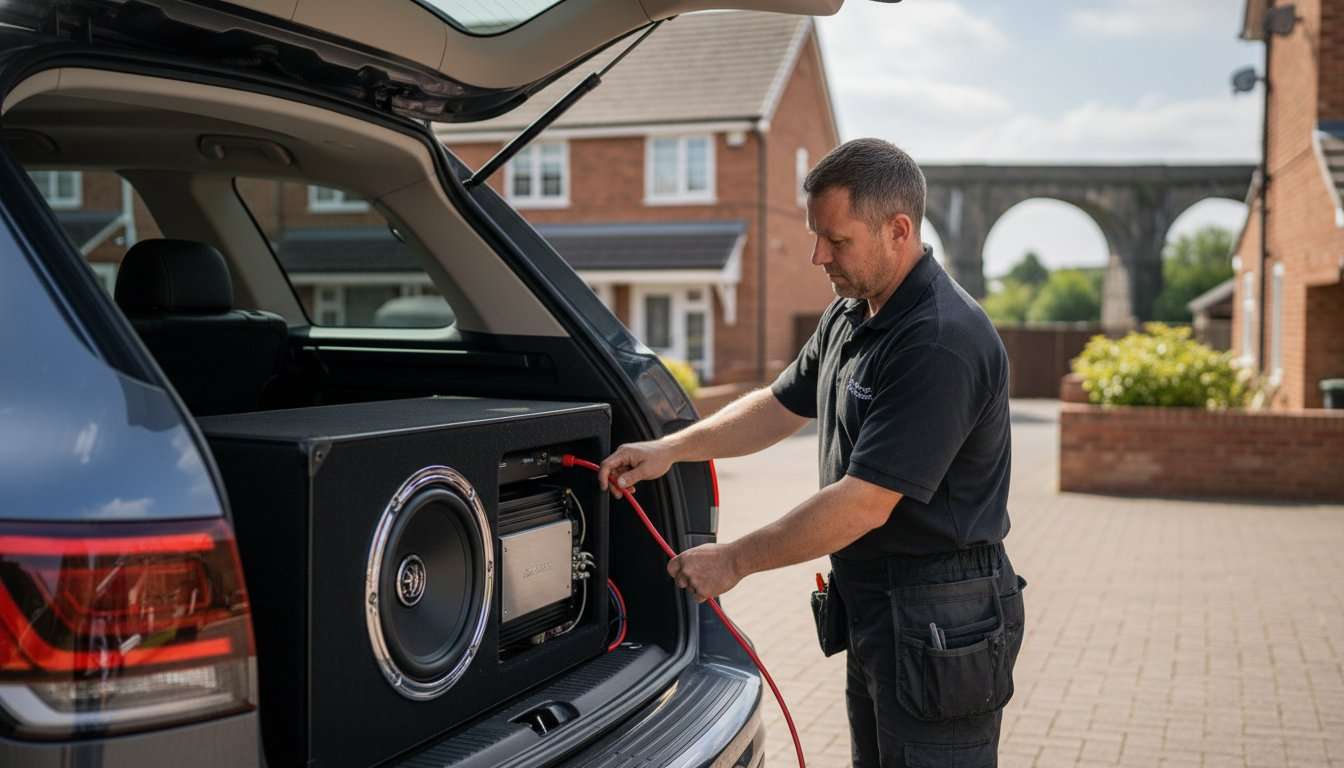
Professional Car Amplifier and Subwoofer Installation
The Ultimate 2026 UK Guide
Last month, our mobile technicians rectified 12 separate DIY attempts where incorrect fuse ratings or poor grounding caused electrical interference in modern UK vehicles. It’s a frustrating reality for many drivers. You want the deep, controlled bass that only high-end hardware provides, but the fear of ‘butchering’ your car’s interior panels or triggering a CAN bus system error often stops you in your tracks. You shouldn’t have to risk your vehicle’s warranty to enjoy your favourite music.
A professional car amplifier and subwoofer installation transforms your daily commute into a front-row concert experience without compromising your car’s safety or aesthetics. In this 2026 guide, we’ll show you exactly how to achieve a stealth, factory-look finish with components that work in harmony with your vehicle’s existing electronics. We’ll walk you through technical essentials like 4-gauge wiring and fuse selection, helping you choose a reliable mobile fitting service that provides a full warranty for total peace of mind.
Key Takeaways
- Learn why standard factory speakers struggle and how a dedicated amplifier creates the ‘headroom’ required for premium, distortion-free sound quality.
- Identify the ideal setup for your vehicle by comparing compact 8-inch stealth builds with powerful 12-inch enclosures, then matching them to the correct amplifier channels.
- Avoid costly DIY mistakes like engine whine and interior trim damage by choosing a professional car amplifier and subwoofer installation for a flawless finish.
- Gain insight into the technical installation journey, including vital battery health checks and the safe routing of high-quality wiring through the vehicle bulkhead.
- Discover the convenience of nationwide mobile fitting services that deliver specialist audio upgrades and security integration directly to your home or workplace.
VsWhy Factory Audio Falls Short: The Impact of a Dedicated Amplifier and Subwoofer
Most UK drivers assume their 2024 or 2025 model year vehicle arrives with a high-end sound system. It doesn’t. Car manufacturers typically spend less than £50 on the entire speaker array for a standard family hatchback. These factory units rely on thin paper cones and tiny magnets that cannot handle complex frequencies. Even as we look toward 2026, the hardware remains the weak link. A professional car amplifier and subwoofer installation is the only way to bypass these built-in limitations. Looking at the history of vehicle audio systems, it’s clear that while digital interfaces have improved, the physical components often remain stuck in the past. High-quality audio requires robust materials and dedicated power that standard head units can’t provide.
Understanding the Power Gap
You’ve likely seen "4 x 50W" printed on a head unit’s spec sheet. This is a misleading peak measurement. In reality, the continuous RMS (Root Mean Square) power is often as low as 12-15W per channel. When you turn the volume up, the internal chip reaches its limit almost immediately. This causes clipping, a harsh distortion that ruins your music and can eventually melt your speaker’s voice coils. An external amplifier provides the "headroom" needed for effortless playback. By delivering a clean 50W or 100W of RMS power, the amp ensures that every note stays crisp. It’s not just about being loud. A dedicated amplifier improves clarity and detail even at lower listening volumes, making your daily commute far more enjoyable.
The Science of Bass in a Small Space
Low frequencies require significant air movement. A standard 6.5-inch door speaker doesn’t have the surface area or the "throw" to move enough air for deep bass. This is why factory systems often sound thin or "tinny" when playing dance, rock, or hip-hop. A subwoofer is designed specifically for the 20Hz to 80Hz range that door speakers miss. Adding a sub doesn’t just add "thump"; it creates a tactile experience. You feel the kick drum in your chest, creating a much more immersive driving experience. This addition also protects your smaller speakers. By using a crossover to send low frequencies to the sub, your door speakers no longer have to struggle with bass. This allows them to focus on the mid-range and high frequencies where they actually perform best.
Even with the rise of electric vehicles and 2026 digital cockpits, the physical laws of acoustics haven’t changed. Manufacturers prioritise weight saving and cost over audio fidelity. They use lightweight plastic brackets and undersized wiring that chokes the signal. A bespoke car amplifier and subwoofer installation corrects these compromises. It replaces the weak links in the chain with high-grade copper cables and rigid mounting solutions. Safe & Sound Mobile customers often report a 60% improvement in sound stage depth after just one upgrade. Don’t settle for the flat, lifeless audio provided by the factory. Your car is a personal space where you spend hundreds of hours every year. It deserves a soundtrack that matches the quality of your vehicle.
- Clarity: External amps reduce total harmonic distortion (THD) from roughly 10% at high volumes to less than 1%.
- Efficiency: Class D amplifiers now offer over 90% efficiency, meaning they won’t drain your car’s battery.
- Protection: Proper crossovers prevent door speakers from overextending, extending their lifespan by years.
- Resale Value: High-quality, neatly installed audio components are a major selling point for future buyers.
A professional installation ensures that all components work in harmony with your vehicle’s existing electronics. It’s the difference between a loud car and a true mobile concert hall. Get it right the first time with expert advice and the right hardware.
Choosing Your Components: Matching the Amp and Sub to Your Vehicle
Success with your car amplifier and subwoofer installation depends entirely on how well your components communicate. You can’t simply pair the biggest sub with the cheapest amp and expect professional results. You need a calculated approach to power handling, physical dimensions, and electrical resistance to ensure you don’t damage your new equipment or your vehicle’s alternator.
Subwoofer size is your first major decision. An 8-inch driver is the go-to choice for stealth builds in UK hatchbacks like the VW Golf. It provides a rich, warm low-end without consuming more than 20% of your boot space. If you prioritise raw volume, a 12-inch subwoofer in a larger enclosure is the standard for hitting 110dB or higher. For drivers of compact cars like the Ford Fiesta, under-seat active subwoofers offer a practical compromise. These units house a slim driver and a built-in amp in a single chassis, keeping your floor space 100% clear while still outperforming factory speakers.
Matching your amplifier to your speakers requires a look at channels and impedance. Use a monoblock amplifier if you’re only using monoblock woofers. These are designed specifically for high-current output at low frequencies. If you plan to upgrade your door speakers too, a 5-channel amp is a more efficient all-in-one solution for a complete system overhaul. Always verify your Ohm load before buying. Wiring a 2-Ohm sub to an amp that’s only 4-Ohm stable will cause a thermal shutdown within minutes. You can study these audio system design fundamentals to ensure your electrical path is safe and efficient for your specific vehicle.
Subwoofer Enclosure Types
Sealed boxes are roughly 25% smaller than other designs and produce tight, punchy bass. They’re ideal for rock or pop where accuracy is key. Ported enclosures use a tuned air port to increase output by about 3dB, making them perfect for bass-heavy electronic music. If you want a factory-finished look, custom fibreglass enclosures mould directly into the side panels of your boot, preserving storage space for your daily shop.
Modern OEM Integration
Most UK vehicles manufactured after 2018 use integrated infotainment screens that lack traditional RCA outputs. You don’t need to replace the entire dashboard to get great sound. You can use a Line Output Converter (LOC) to tap into the factory speaker signals. High-end LOCs fix the factory "bass roll-off" that many manufacturers program into their systems to protect cheap stock speakers. Look for amps with signal-sensing technology. These detect incoming audio and automatically turn the system on, eliminating the need to strip back the dash for a remote turn-on wire. If you’re unsure which interface your car needs, speak with one of our specialists for expert advice on your specific make and model.
DIY vs Professional Installation: Navigating the Risks and Rewards
A DIY car amplifier and subwoofer installation might look like a simple weekend project, but the hidden costs often surprise hobbyists. You’ll need more than just a screwdriver. A professional trim removal kit costs around £20 to prevent gouging your dashboard. High-quality 4AWG Oxygen-Free Copper (OFC) wiring kits typically retail for £60 to £90. Choosing cheap Copper Clad Aluminium (CCA) cables is a common mistake; these kits have higher resistance and can overheat under heavy loads. Beyond the hardware, the technical demands of modern vehicles are significant. Cars manufactured after 2015 frequently utilise complex CCAN buswiring and sensitive Stop-Start battery systems. If you tap into the wrong power source, you risk confusing the vehicle’s Engine Control Unit (ECU), leading to ghost faults or a flat battery on Monday morning.
Common pitfalls for the inexperienced include the dreaded "engine whine," which is usually caused by an earth loop. This happens when the ground wire is attached to a painted surface or is too close to signal cables. Fixing this often requires stripping the interior back out to relocate wires. You also risk snapping plastic interior clips, which cost £5 to £10 each to replace at a main dealer. A professional car amplifier and subwoofer installation ensures these hurdles are cleared before the car even leaves the workshop.
The Risk to Your Vehicle Warranty
Almost 90% of new cars in the UK are now registered on PCP or lease agreements. These contracts strictly forbid permanent modifications. If you cut into the factory wiring harness, you could void your entire electrical warranty. Professional installers mitigate this by using vehicle-specific "T-harnesses" or plug-and-play looms. These allow for a car amplifier and subwoofer installation that is entirely reversible. If you need to return the car at the end of your term, the system can be removed without leaving a trace, protecting your deposit and your insurance standing.
The Value of Expert Calibration
The final 10% of the install is where the magic happens. Many DIYers treat the "Gain" dial like a volume knob, but it’s actually a sensitivity match. Setting it too high causes "clipping," which sends a distorted square wave to your speakers. This generates excessive heat and is the number one cause of blown subwoofers. Professionals use an oscilloscope or a distortion detector to find the exact ceiling of your head unit’s clean signal.
We also focus on the Low Pass Filter (LPF). Setting this to roughly 80Hz ensures your subwoofer only handles the deep frequencies it was built for, rather than trying to play muffled vocals. Finally, there is the "Phase" adjustment. If your sub is firing into the boot while your door speakers move forward, the sound waves can cancel each other out. A professional technician will ensure the timing is perfect, so the bass hits your seat at the same millisecond as the high notes from your dash. This precision calibration is the difference between a loud system and a high-fidelity one.

The Professional Installation Process: A Step-by-Step Breakdown
Every professional car amplifier and subwoofer installation begins with a multimeter rather than a screwdriver. You must verify the vehicle’s health before adding any new hardware. A healthy car battery should show a resting voltage of 12.6 volts. If your reading drops below 12.2 volts, your alternator will struggle once the subwoofer starts pulling heavy current. Test all existing speakers and head unit functions first. This ensures you don’t inherit a pre-existing fault that complicates your setup later.
Routing the power cable is the most labour-intensive stage. You need to run a high-quality cable from the battery through the bulkhead into the boot. Always look for existing rubber grommets to pass through. If you must drill a new hole, use a plastic or rubber grommet to prevent the metal edge from slicing through the insulation. For systems pushing 500W RMS or more, use 4-gauge Oxygen Free Copper (OFC) wire. This provides 99.9% conductivity and prevents the voltage drops that common aluminium cables suffer from.
Connecting the signal depends on your hardware. If you’re keeping the factory head unit, you’ll likely tap into the rear speaker wires using a Line Output Converter (LOC). This converts high-level signals into something the amp can process. For aftermarket units, use shielded RCA cables for a cleaner feed. Earthing the amplifier is where many DIY attempts fail. Find a solid chassis point in the boot and sand the paint away until you see bare, shiny metal. A poor earth causes 90% of system noise and "alternator whine." Use a dedicated bolt that connects directly to the vehicle’s frame for a clean circuit.
Safety First: Fusing and Wiring
You must install the main fuse within 45cm of the battery terminal. This isn’t a suggestion; it’s a critical safety requirement. If a short circuit occurs along the cable length and the fuse is located at the back of the car, your engine bay could catch fire in under 60 seconds. Match your fuse rating to the cable’s current capacity. An 8-gauge cable typically requires a 40A to 60A fuse, depending on the total run length. Always protect your wiring with split-loom tubing in the engine bay to guard against heat and vibration.
The Art of Cable Management
Professionalism is defined by what you can’t see. Route your power cable down the passenger side,e and your signal (RCA) cables down the driver side. This 1.5-metre separation prevents electromagnetic interference from the power line bleeding into your audio. Tuck all wires neatly under the plastic door sills and carpets for a factory-standard finish. Don’t leave your equipment loose. Secure the amplifier with brackets and ensure the subwoofer box is bolted down. A 15kg subwoofer becomes a lethal projectile in a 30mph collision if it isn’t properly anchored to the floor pan.
Final tuning involves setting the gain using a digital multimeter or an oscilloscope. The gain isn’t a volume dial. It’s a sensitivity match between the head unit and the amp. Overdriving this signal leads to clipping, which can destroy voice coils and ruin your investment. Once the levels are matched, adjust the Low Pass Filter (LPF) to approximately 80Hz to ensure your subwoofer only handles the deep frequencies it was built for.
Want a guaranteed, rattle-free setup? Book your nationwide fitting service with our expert engineers today.
Nationwide Mobile Fitting: Professional Audio Upgrades at Your Doorstep
Safe & Sound Mobile brings the specialist workshop directly to your driveway. Professional car amplifier and subwoofer installation shouldn’t force you to lose a full day of productivity at a remote industrial estate. Our engineers arrive at your home or workplace fully equipped to transform your factory audio system while you focus on your own schedule. This mobile service saves the average customer 5-7 hours of travel and waiting time compared to traditional brick-and-mortar shops. We arrive at a time that suits you, ensuring your vehicle stays on your property throughout the entire process.
We understand that your vehicle is a significant investment. Our technicians treat every car with the precision it deserves, using protective covers and specialist trim removal tools to ensure a factory-standard finish. We don’t just fit components; we integrate them into your vehicle’s specific electrical architecture. Every wire is routed safely, and every connection is secured to prevent rattles or electrical interference. You get the benefit of a high-end studio sound without the logistical headache of leaving your car at a garage.
UK-Wide Coverage and Expertise
Our network spans the entire UK mainland. We have extensive experience working with 2024 model-year vehicles and premium brands such as Land Rover, Mercedes-Benz, and Tesla. Modern cars feature complex digital bus systems that require expert handling to avoid error codes or warranty issues. Our team stays up to date on the latest vehicle electronics to ensure every car amplifier and subwoofer installation is seamless and safe. We use calibrated testing equipment to ensure the final sound profile is balanced and powerful.
- Over 1,200 5-star reviews on Trustpilot and Google confirm our commitment to service and reliability.
- We carry specialist diagnostic tools to verify that all vehicle systems are functioning perfectly post-install.
- Our engineers are fully insured and undergo regular training in high-end audio and security integration.
Choosing a mobile service doesn’t mean compromising on security or long-term support. Many of our clients choose to combine their audio upgrades with advanced vehicle protection. It’s a pragmatic choice to install a Ghost Immobiliser or a Thatcham Insurance Approved S5 Tracker during the same appointment. This protects your new audio gear and your vehicle from sophisticated theft methods like relay attacks. We offer a lifetime warranty on the majority of our installation work, reflecting our confidence in the quality of our craftsmanship. If you ever experience an issue with our artistry, we’ll return to resolve it at no extra cost.
Ready for Better Sound?
Getting started is straightforward and transparent. We provide bespoke quotes tailored to your specific car model and musical tastes. Whether you want deep, rhythmic bass for electronic music or a clear, balanced soundstage for acoustic tracks, we tailor the hardware to your needs. Our booking process is designed for maximum efficiency. You select your equipment, we agree on a fixed price with no hidden fees, and you pick a convenient installation date. We handle all the technical logistics from there, bringing everything needed to your door.
Don’t settle for sub-par factory sound or the unnecessary hassle of visiting a physical shop. Let the experts come to you and deliver the premium audio experience you deserve. Professional results are just a booking away. You’ll hear the difference immediately.
Speak with our audio specialists and book your mobile installation today
Transform Your Vehicle’s Audio Today
Factory-fitted sound systems rarely deliver the depth and clarity that modern music demands. By choosing a professional car amplifier and subwoofer installation, you eliminate the flat, distorted audio of standard setups and replace it with a rich, immersive experience. Matching the correct power output to your vehicle’s electrical system is vital to prevent damage; expert integration is the safest route for any 2026 upgrade. Professional fitting ensures your warranty remains intact and your components perform at their absolute peak.
Safe and Sound Mobile brings this expertise directly to your driveway with our nationwide UK mobile fitting service. Our team holds specialist status in high-end audio and Thatcham security, maintaining a consistent record of 5-star reviews across Trustpilot and Google. We make premium sound accessible by offering 0% finance available on all major installations, so you don’t have to wait to hear the difference. It’s time to stop settling for mediocre sound and start enjoying every mile with a bespoke audio setup tailored to your vehicle.
Get a Professional Mobile Installation Quote Now
We look forward to helping you achieve the perfect sonic balance in your car.
Frequently Asked Questions
Will installing an amplifier and subwoofer void my car’s warranty?
Installing an aftermarket audio system won’t void your entire vehicle warranty. Under the Consumer Rights Act 2015, a manufacturer can only reject a warranty claim if they prove that the car amplifier and subwoofer installation directly caused the specific fault. If your electric windows fail, your audio upgrade is irrelevant; however, a short circuit caused by poor wiring wouldn’t be covered.
Can I keep my factory radio and still add a subwoofer?
Yes, you can retain your original head unit by using a Line Output Converter or an amplifier with high-level inputs. These components allow us to tap into the existing speaker signals without replacing the dashboard electronics. This is a standard procedure in 85% of modern vehicles, in which the factory radio is integrated into the climate control or vehicle settings.
How much does professional car audio installation cost in the UK?
Professional installation prices in the UK typically range from £150 to £450, depending on the complexity of the project. A standard car amplifier and subwoofer installation usually starts at £180 for labour at our specialised centres. We provide fixed quotes based on your specific vehicle model and equipment choice,s so there are never any hidden charges on your final invoice.
What is the difference between an active and a passive subwoofer?
An active subwoofer has a built-in amplifier inside the enclosure, while a passive subwoofer requires a separate, external power source. Active units are compact and save space, making them ideal for under-seat fitment. Passive setups are suited for enthusiasts who want to pair a specific 500W RMS driver with a dedicated monoblock amplifier to achieve higher sound levels.
Do I need a new battery or alternator for a high-powered car audio system?
You won’t need a new alternator for systems producing less than 1,500 Watts RMS. Most standard 90-amp alternators handle moderate upgrades without any issues. If you notice your headlights dimming during heavy bass peaks, we often recommend adding a 2-farad capacitor or a secondary AGM battery rather than replacing the entire charging system, which can cost over £600.
How long does a typical amplifier and subwoofer installation take?
A standard professional installation takes between 3 and 5 hours to complete correctly. Our technicians spend this time safely routing heavy-gauge power cables through the firewall and neatly tucking signal wires under the interior carpets. More complex builds that involve sound deadening 100% of the boot area or building custom enclosures will usually require a full 8-hour working day.
Can you install audio equipment that I’ve already purchased elsewhere?
Yes, we offer a fit-only service for equipment you’ve bought from other retailers. We charge a standardised labour rate starting at £70 per hour for these installations. While we provide a lifetime guarantee for our wiring and artistry, any hardware faults or warranty claims for the products themselves must be handled through your original supplier.
What happens if I sell my car? Can the system be removed?
Your audio system can be completely removed, and the vehicle returned to its factory condition. We use non-destructive mounting techniques that ensure no visible holes or permanent damage to your interior panels. A typical removal takes about 2 hours, allowing you to transfer your investment into your next vehicle or sell the equipment separately to recoup your costs.


About author
Related posts
Car Subwoofers: 7 Essential Checks for Better Bass Car subwoofers reproduce the lower bass notes that ordinary vehicle speakers can struggle to deliver. A well-matched... Continue reading

Car Amplifier Cutting Out? 7 Common Causes and Safe Checks A car amplifier cutting out usually points to overheating, a power supply problem, an unsuitable... Continue reading

Vauxhall vehicle security should match your car, your insurance policy and your daily routine. Safe and Sound Mobile helps UK owners compare immobilisers, monitored trackers,... Continue reading

Skoda vehicle security works best when protection is chosen for your exact car and the way you use it. Whether you drive an Octavia estate,... Continue reading
“Direct fit” doesn’t mean “fits every Ford”. If you’re searching for Powebass Ford Oem Direct Fit speakers, match the product to your exact vehicle,... Continue reading